I remember a quick reference to the Hanseatic League in my Dutch history classes, but I did not learn much more about it until I came across another reference in a university class in the United States. Since then, I often think about the Hanseatic League and what it means in today’s world.
The early form of the Hanseatic League goes back to the 1100s and consisted of friendly trading relationships between towns and merchant communities around the Baltic and North Sea. They fished for herring along there shores but then it suddenly disappeared in the 1200’s and was rediscovered closer to the North Sea.
The movement of herring stocks was long something of a mystery. More recent research suggests that changes in fish populations were influenced by a combination of overfishing and environmental and climatic factors, although the precise causes remain debated. Either way, it was an early lesson in the interaction between natural resources, climate, and human economic activity.
The German and Baltic fisheries were now faced with a problem — and an opportunity. Herring was a desirable commodity because Christians ate fish on Fridays and during other religious fasts. While herring was relatively cheap, it spoiled quickly. Salting was the main method of preservation, and salt came from Lüneburg, some distance inland from Lübeck. Salt could be shipped more easily through Hamburg, which helped establish maritime trade routes connecting salt production, fishing communities, and commercial centers. The Hanseatic trading network eventually connected places such as Lübeck, Hamburg, and Bergen, Norway, where preserved fish and other commodities could be exchanged and shipped onward.
Nothing terribly special there.
Maritime trade routes like this had waxed and waned for millennia around the world. Venice was doing something similar at about the same time in the Mediterranean. But there were subtle differences. While Venice often played for dominance and control of trade, the northern trade developed more as a league approach: the Hanseatic League.
Instead of a monopoly, the Hanseatic League more closely resembled a cartel or, more accurately, a trade alliance.
There are many options in the development of maritime trade. One can simply go with the traditional — and often incorrectly characterized — Viking approach of uncooperative rape and pillage (zero-sum trade), all the way to fully cooperative maritime trade.
From a game-theory point of view, this northern trade had many of the hallmarks of an iterated prisoner's dilemma. Instead of one big haul, the trade depended on long-term reliance and many transactions between partners, with each contributing a piece of the puzzle. That characteristic is extremely powerful and is a core source of cooperation in evolution, nature, social settings, and commerce.
True maritime trade — not rape and pillage — needs credit, currency, contracts, and eventually financial agreements between financiers and the various cities and merchants involved in the trade. Next came insurance, trade agents, and other mechanisms for reducing commercial risk. Since it was a commercial venture, other cities and trading communities wanted in on the game. As long as everybody played by reasonably consistent rules, there was no obvious limit to its growth.
Soon the trade expanded from fish to other products, and by the 1400s the Hanseatic League was a major force in northern European commerce, with trading connections extending from the eastern Baltic to London and along the Rhine to Cologne. Almost all the participants in the League were cities, and if one city stopped participating or violated the interests of the others, the other cities could boycott it or shift their trade, all without a formal central government structure. Meanwhile, very high levels of operational agreement and standardization strongly increased any merchant's holy grail: high predictability and steady profits.
It was far from all sweets and roses. The cities also maintained military capabilities, and ships from different cities could be combined into fleets to fight aggressors and pirates.
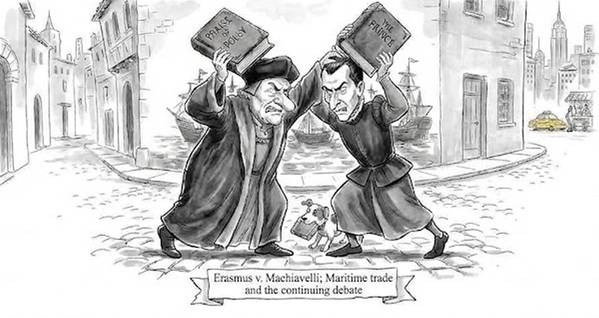
While nowhere near as glitzy as the Southern Renaissance, the Northern Renaissance was real and had its own character, although the distinction between a "Northern" and "Southern" Renaissance can be overstated. The differing commercial environments did, however, influence local philosophy and political thought. The North talked in terms of Erasmus—humanism and moral ethics—while the South talked in terms of Machiavelli—power and dominance.
Crazily, Erasmus and Machiavelli were almost exact contemporaries, and the comparison of their philosophies can seem to describe today's political polarizations almost exactly.
A maritime trade network can create great wealth, with inherently high incomes per person. This is difficult to achieve on land, where the transportation of trade goods was incredibly expensive and therefore constrained economic growth. However, feudal landed gentry had its own asset: serfs, and the ability to whip them up in envy of nearby Hanseatic towns. While a single sailor can carry many times more cargo than a serf, on land a serf with a gun is no worse than a sailor with a gun.
This instability contributed to the demise of many city-states and the creation and consolidation of nation-states in both the South and North of Europe.
The Hanseatic League eventually disappeared, but so did the great maritime republics of the Southern Renaissance. Venice lasted longer, in part because it took longer for nation-states to organize and challenge its position in the Mediterranean. In effect, neither model proved immune to the rise of the nation-state.
This would indicate that the Northern and Southern Renaissance concepts were both doomed.
But maybe not, and maybe the Northern approach holds more inherent promise.
After a number of centuries of nation-state strife, what we have today is a Europe that, in some important respects, functions more like a Hanseatic League than a Venetian single-entity dominance model.
Just like the Hanseatic League, in the European Union—and NATO—there are misguided efforts at freeloading, overplaying one's hand, and even moves to secede, along with lots of bickering. But as long as they stick together and work together, everybody in the league benefits.
It would appear that the Northern Renaissance concept is the real winner and perhaps can be Ben Franklin paraphrased as:
"It is a league, if you can keep it."
For every column I write New Wave Media makes a small contribution to an organization of my choice. For the foreseeable future I am selecting SL7Expo. An industry wide effort to develop a Smithsonian level exhibit center for commercial maritime.