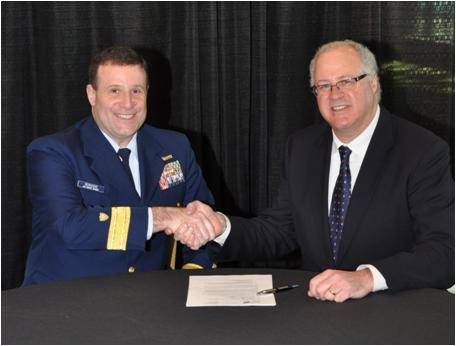
The Passenger Vessel Association (PVA) & the U.S. Coast Guard sign policy agreement regarding Coast Guard approval of fire protection for newly constructed high-speed vessels.
This agreement is critical to the U.S. shipbuilding industry to ensure delivery of Coast Guard-approved high-speed passenger vessels.
The product of a chartered working group of experienced PVA member industry experts and Coast Guard policy specialists, the agreement details guidelines for pre-approved design criteria including seating arrangements and space dimensions. This solution allows boat builders to meet the standards of fire safety while facilitating the building of lightweight high-speed aluminum vessels, currently in strong demand.
“This agreement ensures high fire protection standards for the safety of passengers and vessels but also provides a pathway for vessel designers, builders, and owners to obtain Coast Guard approval of their building plans,” said 2012 PVA President Paul Belforti. “It returns confidence to the market in that vessels of this type can now be constructed cost effectively.”
The revisions to Coast Guard Navigation and Vessel Inspection Circular (NVIC) 9-97-1 were produced utilizing research advances in fire modeling from the designs of working vessels to most accurately test dimensions and configurations with performance-based engineering analysis.
In the picture (l to r) Rear Admiral Joseph A. Servidio, Assistant Commandant for Prevention Policy, United States Coast Guard and Paul Belforti,
2012 President, Passenger Vessel Association.