Return to Bremerhaven: The research vessel 'Polarstern' returns with new findings from the Central Arctic during the 2012 ice minimum.
After a good two months. 54 scientists and technicians from twelve different countries conducted research on the retreat of the sea ice and the consequences for the Arctic Ocean and its ecosystems
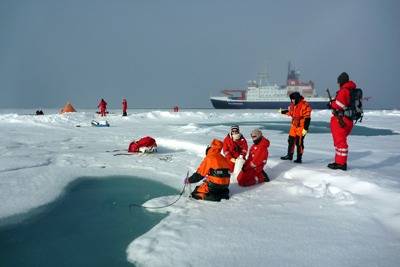
Since its departure from Tromsø (Norway) on 2 August 2012 Polarstern has travelled some 12,000 kilometres and conducted research at 306 stations. These included nine ice stations where the ship moored to an ice floe for several days to examine the ice, the water beneath it and the bottom of the sea.
Many measurements were concerned with responses to the rapid retreat of the sea ice this summer. The researchers determined that the thick multiyear sea ice in the area of investigation had declined further. With the so-called EM-Bird (electromagnetic sensor to record the thickness of sea ice) an area of 3,500 kilometres of sea ice was measured from a helicopter. As early as July 2012 the Siberian shelves including the Laptev Sea were free from ice, whereas in the summer of 2011 Polarstern had still encountered multiyear ice in this region.
This means that the volume of ice is greatly reduced by melting. The fresh water content of the sea surface has increased accordingly as a result of the melting ice. “The Arctic of the future will consist of thinner sea ice which will therefore survive the summer less frequently, will drift more quickly and permit more light to penetrate the ocean. This will lead to great changes in the composition of sea life“, says head of the expedition Prof. Dr. Antje Boetius, who manages the Helmholtz-Max-Planck Research Group for Deep-sea Ecology and Technology at the Alfred Wegener Institute.