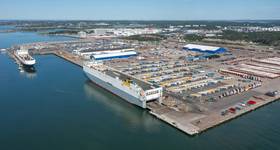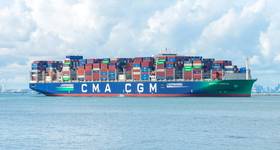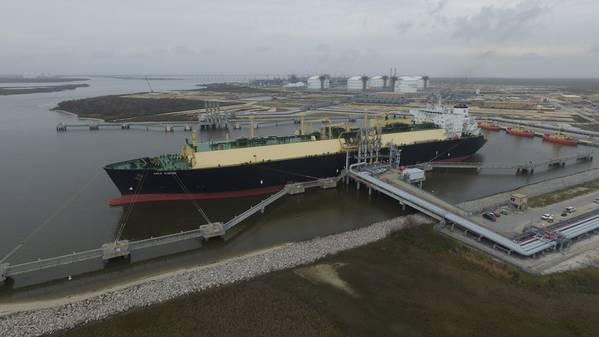
A liquefied natural gas (LNG) vessel, the Maria Energy, arrived at Cheniere Energy Inc's $15 billion Corpus Christi LNG export facility in Texas on Saturday, according to Reuters vessel tracking data.
This is the second vessel to visit Corpus since Cheniere started producing LNG in November at the plant's first liquefaction train, a building-sized unit used to cool natural gas into LNG. It could be the first vessel to pick up a cargo there.
Cheniere said the first vessel, LNG Golar Tundra, did not pick up LNG. The company, however, did not say why the vessel was at Corpus.
Officials at Cheniere were not immediately available to say whether Maria Energy would pick up any LNG. Traders have noted the facility has been producing LNG since the middle of November.
Corpus Christi is the third big LNG export terminal to enter service in the lower 48 U.S. states.
The first was Cheniere's Sabine Pass terminal in Louisiana, which sent out its first cargo in February 2016. Since then, Sabine has delivered around 500 cargoes to at least 29 countries and regions around the world.
The company has said it expects Corpus 1 and the fifth liquefaction train at Sabine Pass to enter commercial service in the first quarter of 2019, followed by Corpus 2 in the second half of 2019 and Corpus 3 in the second half of 2021.
Each of Cheniere's trains is capable of liquefying about 0.7 billion cubic feet per day (bcfd) of natural gas. One billion cubic feet is enough to fuel about 5 million U.S. homes for a day.
U.S. LNG exports have almost quadrupled from 183.9 billion cubic feet (bcf) in 2016 to 706.4 bcf in 2017, worth about $3.3 billion, and are on track to rise to over 1,000 bcf in 2018, making the United States one of the world's biggest exporters of the super-cooled gas.
Total U.S. LNG export capacity is expected to jump to 5.2 bcfd by the end of 2018, 8.9 bcfd by the end of 2019 and 10.3 bcfd by the end of 2020 from 4.5 bcfd now, which should make the United States the world's third-biggest LNG exporter by capacity in 2019.
Cheniere is also developing a sixth 0.7-bcfd train at Sabine Pass and seven smaller 0.2-bcfd trains and other opportunities at Corpus.
Cheniere has estimated the cost of the first five trains at Sabine, including financing, at between $17.5 billion and $18.5 billion.
Reporting by Scott DiSavino