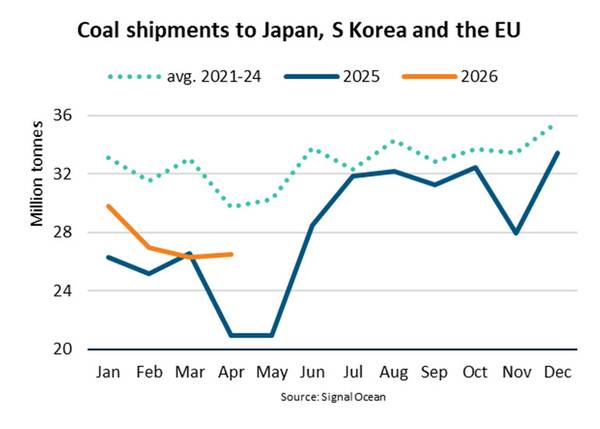
Coal shipments to Japan, South Korea and the European Union rose 27% year-on-year in April as tight gas supplies and disruption to LNG shipments prompted buyers to seek alternative fuel sources for electricity generation, shipping association BIMCO said.
The increase came as the closure of the Strait of Hormuz disrupted LNG exports from the Persian Gulf and contributed to an 8% decline in global seaborne LNG shipments in April, BIMCO said.
“In April 2026, coal shipments to Japan, South Korea and the EU jumped 27% y/y as these countries seek alternative energy supplies to gas to meet their electricity demand. The closure of the Strait of Hormuz has disrupted LNG shipments out of the Persian Gulf and has contributed to an 8% y/y drop in global seaborne LNG shipments in April,” said Filipe Gouveia, Shipping Analysis Manager at BIMCO.
Coal imports into the three markets typically decline in April and May as heating demand eases, but shipments rose 1% month-on-month this year despite lower seasonal demand, BIMCO said.
Japan, South Korea and the EU account for about 25% of global coal cargo volumes and 31% of tonne-mile demand for coal shipping, according to the association.
“The rise in coal shipments to the EU, Japan and Korea have contributed to an 8% y/y increase in global tonne mile demand for coal in April 2026. Although sailing distances to these countries are on average 7% shorter than the global dry bulk average, they are still 23% longer than the global average for coal. The increase in ship demand is supporting freight rates, especially for the panamax and capesize segments,” added Gouveia.
Panamax vessels account for 58% of coal shipments to the three regions, while capesize vessels transport another 31%, BIMCO said.
The association said continued disruption at the Strait of Hormuz could further increase coal demand in advanced economies as utilities switch from gas to coal-fired generation.
Under that scenario, BIMCO forecasts global coal shipments could grow by as much as 1% in 2026 and 0.5%-1.5% in 2027.
“In the long term, we expect coal shipments to the three economies to gradually decrease, regardless of transit conditions through the Strait of Hormuz. Electricity generation capacity from renewables is expected to continue to grow, and the recent spike in energy prices could accelerate this transition,” concluded Gouveia.