What does a new year of training look like at SCI? With a new simulator in full operation, SCI helps individual mariners complete assessments previously only available in large class settings or in the real world when exact conditions could be met on the water.
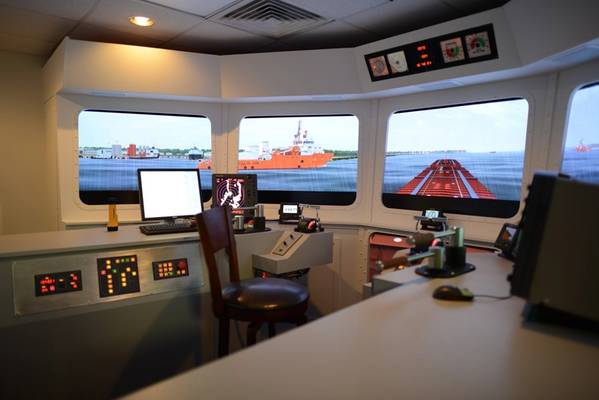
The Seamen’s Church Institute’s (SCI) Center for Maritime Education puts mariners in real-life situations using high-tech simulation equipment. Most days, SCI classrooms host groups of six to eight students as part of training sessions sponsored by maritime transportation companies; however, thanks to a new simulator bridge installed at SCI’s Houston Center last fall, mariners do not have to come to SCI as part of a group or business to train or undergo assessments on tasks needed to maintain license certification. The new simulator offers affordable one-on-one assessments to help mariners meet their individualized training goals.
SCI’s new simulator allows mariners to obtain credentials for licenses, including the Towing Officer Assessment Record (TOAR) and radar recertification. It also helps mariners applying for new jobs and assignments, allowing them to demonstrate their skills to the company. Programmable simulations also let candidates demonstrate their ability to handle new challenges and geographic locations.
Recently, SCI helped one such mariner advance his career with the newly installed simulator. The mariner needed to complete a TOAR, an often difficult-to-arrange assessment requiring a skills appraisal in a specific geographic location. In this case, the mariner had worked on the waters for two years and had received good preparation from his captain, but his experience had not yet required him to navigate through a lock system.
SCI’s instructors and a designated examiner (DE) set up an exercise that would teach the mariner the needed skills. Then, they tested his knowledge and competency on the simulator navigating through a model of a real lock on the river. They arranged several one-hour sessions with varying degrees of involvement from the DE. During the final run, the DE exited the simulator and sat in the observation room. With three sessions on the simulator, the mariner passed the assessment, receiving signoffs on five mandatory TOAR maneuvering procedures.
On review of the process, the DE commented that the student learned very quickly. If he made a mistake on the first run, the examiner noted, he corrected it in the subsequent trial. By the third run, the mariner had acquired the skills necessary to complete the maneuvers without any help from the DE. The simulator provided a familiar environment—so realistic that the mariner could apply his experience on the water—to learn new skills quickly and easily.
In 2014, SCI harnesses the power of this technology to help more professionals in the maritime industry. Because of the Transas simulator’s extreme adaptability, additional uses include instruction for mooring masters, the development of feasibility studies and, with the flip of a switch, nighttime simulations.