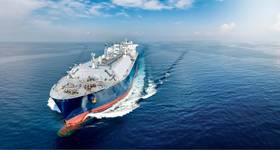
Five new Arc 7 design ice-class LNG carriers being built at the Daewoo Shipbuilding and Marine Engineering (DSME) yard in South Korea will be powered by a total of 30 Wärtsilä 50DF dual-fuel engines. The vessels will operate in arctic conditions to serve the Yamal LNG project in Northern Russia. The order was placed in January with Wärtsilä's joint venture company, Wärtsilä Hyundai Engine Co. (WHEC) who will also build the engines in South Korea.
Each of the LNG carriers will be fitted with four 12-cylinder Wärtsilä 50DF engines and two 9-cylinder Wärtsilä 50DF engines. The engines will primarily utilise liquefied natural gas (LNG) as fuel, but are also capable of running on conventional marine diesel fuels. When operating in arctic conditions, the vessels will be required to handle ambient temperatures of as much as minus 50 degrees Celsius, and to break through ice up to two metres thick. This requires dramatic variations in engine load within a short time span, and the Wärtsilä engines were considered as being the most suitable for these extremely challenging conditions.
"Altogether, Wärtsilä has been contracted within the past twelve months to supply 90 dual-fuel engines to fifteen of these Arc 7 ice-class LNG carriers for the Yamal project. This is a clear endorsement of the very high efficiency and reliability of the Wärtsilä machinery, which owners and shipyards around the world recognise. It is a pleasure to cooperate with DSME and the vessel owners in meeting the demands of arctic operations," says Mr Lars Anderson, Vice President, Wärtsilä Ship Power.
Yamal LNG is a Russian project, which by the end of 2017 is expected to produce 16.5 million tons of LNG per year for shipment to European, Asian and South American customers.
The Wärtsilä 50DF engine
The Wärtsilä 50DF engine is manufactured in various configurations from a 6-cylinder in-line version to an 18-cylinder version in V-configuration, giving 950/975 kW per cylinder and a total maximum mechanical output of 17,100 kW. The engine speed is 500 or 514 rpm with 50Hz and 60 Hz applications. The maximum thermal efficiency is higher than with any other gas engine.
When operating in gas mode, the nitrogen oxide (NOx) emissions are at least 85 percent below those specified in the current IMO regulations, and CO2 emissions are some 25 percent less than those of a conventional marine engine running on diesel fuel. Additionally, the sulphur oxide (SOx) and particle emissions are negligible at almost zero percent.