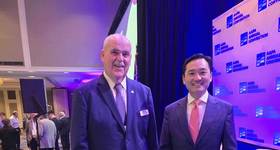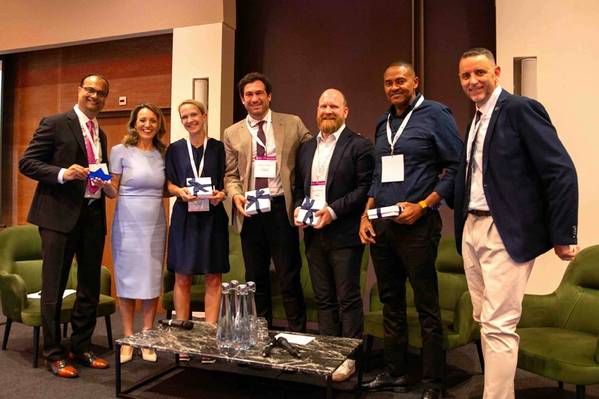
Companies from Africa, Europe, the US and Latin America offered strategies for steering through a challenging period of complex geopolitics, price volatility and supply chain congestion at a session of The Heavy Lift Group's (THLG) 74th Annual Conference.
Moderated by Colin D'Abreo, VP Director Rhenus Project Logistics Global, panellist Iris Mueleians, Managing Director of Germany's Ried Group, told an international audience that customer priorities focused on securing local know-how to manage risk, price stability over time and help towards achieving zero emissions.
With projects sometimes taking two to three years to come to fruition, factoring in general inflation and rising fuel prices was now a feature of customer agreements to help manage forward costs, Muellejans said.
Being close to the market to identify challenges early was also a vital skill for carriers, she said, citing regular lock closures on German waterways. "It can be a critical price increase if there are no barges left because there's a lock closure or you can't execute the project," she added.
Nevertheless, unexpected developments could undermine even the best laid plans, according to Ragan Watson, Project Manager for Sales, of US-based Barnhart Crane & Rigging. Spiraling fuel costs due to events in the Strait of Hormuz had led to major impacts on tender pricing.
The tariff situation has also been very disruptive, he added: "Not long after some of these policies were implemented, we saw several major capital projects cancelled." Others were postponed, with knock-on disruption to Barnhart's program over the next 18 months. "That also creates challenges for other obligations that were scheduled thereafter."
Other disruptive market forces were also starting to leave their mark on logistics, Watson observed. The development of Al computing centers in North America was outstripping transport capacity, with spiking demand for power encouraging project cargo clients to put work out to tender earlier, he said.
Infrastructure lag
The challenge posed by infrastructure developments that lag behind surging demand is also pressing in Africa and Latin America, according to Maurice Mburu, CEO of Kenya-based ECS and Murilo Caldana, Project Director for freight forwarder FOX Brasil, respectively.
"Africa is charting formidable growth trajectories grounded on massive demographic shifts and demand for minerals," said Mburu. He cited cobalt mining developments in DRC Congo and lithium mines in Zimbabwe and Namibia serving international demand while the number of African cities with populations in excess of 5 million are rapidly expanding the demand on and or regional infrastructure.
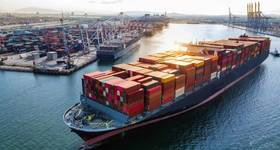
At the same time, challenges facing ECS included congestion in the ports of Lamu and Mombasa, as well as the hidden costs of managing mis-arrivals. In the background businesses elsewhere were exposed to sovereign debt distress, with the higher interest rates brought by debt restructuring creating underlying pressures on business.
Caldana emphasized the way Latin America was seeing a shift in its cargo profile, with the emphasis moving away from agricultural commodities and towards infrastructure development, mining, and other power projects including green energy. A boom in oil and gas projects in Columbia was driving demand for FPSO vessels while the oil industry was reopening in Venezuela, and major green energy projects were underway in Chile, Guatemala and Honduras.
Projects for the pulp and paper industries in Brazil, Uruguay and Paraguay could require up to 100,000 freight tons of equipment plus containers and individual loads of up to 400 tons, he added, while the expansion of data centers was also a notable trend across the region.
Self-starting risk management
In addition to the unpredictability of long-term pricing, Caldana said carriers in the region faced the issue of dealing with different currencies. "This is very challenging because we also have to assume the risk of fluctuations against the US Dollars or the Euro."
Companies had to maintain very good cash flows so that they could guarantee lines of credit, which could be a particular in markets like Brazil at a time when annual interest rates were running at up to 15%.
Faced by such a broad range of issues, panellists explored how self-starting often provided the basis for better answers.
Mburu said, instead of importing end to end from the source market, carriers in Africa had sought to make greater use of hub and spoke operations. The market was also experiencing more openness to partnering between enterprises, in an effort to move cargo off the roads and onto rail. Al was also in increasing use to get the best freight rates and improve cargo tracking.
"We're also working to find ways to continue work with strategic partners throughout our network, particularly THLG," Watson added, "whether we're tendering at the service provider or partnering with others to supplement the service that we offer our clients."