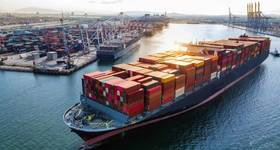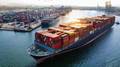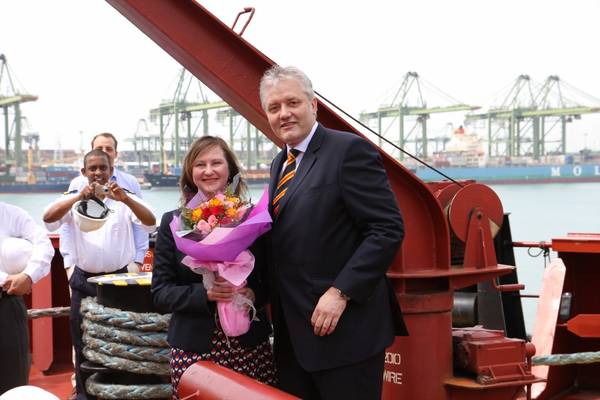
Hamburger Lloyd holds Singapore naming ceremony for the China-built 5000 TEU container ship 'RHL Fidelitas'.
The 5000 TEU container vessel RHL Fidelitas, was built by Jiangnan Changxing Heavy Industries shipyard and is the third ship of this kind in Reederei Hamburger Lloyd’s fleet.
The vessel was named with the traditional bottle of champagne smashed by Jennifer Ritter the wife of Mr Michael Brandhoff, Technical Director at Hamburger Lloyd.
Like her sister vessels RHL Fiducia and RHL Felicitas“ the RHL Fidelitas measures 294.0 m in length and 32,2 m in width. She can carry 63,500 tons of cargo at a maximum draught of 21.8 m and can stow 2,274 TEU in her holds and 2,637 TEU on deck, up to seven tiers high. Her homogenous loading capacity amounts to 3,350 TEU at 14 tons each and there are 385 reefer sockets available.
Propulsion power comes from a MAN type 8K98MC main engine, with a power output of 45,760 kW, to give a cruising speed of 25.2 knots and the vessel is classified by Germanischer Lloyd.
Currently, the RHL Fidelitas is under charter by Pacific International Lines, sailing on the Far East/Redsea route.