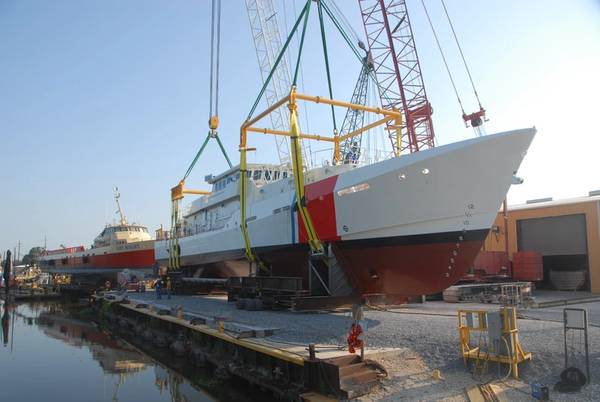
Vessel named for Coast Guard hero Richard Etheridge.
The U.S. Coast Guard’s second, 154-foot Fast Response Cutter, the Richard Etheridge, was launched at Bollinger Shipyards in Lockport, La., Thursday, marking a significant milestone in the Coast Guard’s acquisition of the Sentinel- class patrol boats.
While in the water, the cutter will undergo a series of tests and evaluations prior to its planned delivery early next year. The launch is one of many steps in the construction process, leading to sea trials and crew training later this year and, eventually, the commissioning of the vessel and commencement of its Coast Guard operations. The Sentinel-class patrol boats are the replacement for the service’s legacy Island-class, 110-foot patrol boats.
The Richard Etheridge will be capable of reaching speeds in excess of 28 knots and is designed to independently conduct multiple missions including port, waterways and coastal security; fishery patrols; search and rescue; and national defense. The Sentinel-class patrol boat is equipped with a stern launch ramp that allows the vessel to deploy its cutter boat in a wide range of sea conditions.
The Richard Etheridge’s 24-person crew will conduct additional testing and evaluation prior to the cutter’s commissioning in 2012. The cutter will be homeported in Miami and will primarily perform missions to save lives, enforce U.S. and international maritime law, and ensure security in the Coast Guard’s 7th District area of responsibility that includes the nation’s Southeastern maritime border and the Caribbean Sea.
The third Fast Response Cutter, the William Flores, is tentatively scheduled to be launched Nov. 10.
All Sentinel-class Fast Response Cutters will be named after enlisted Coast Guard heroes. Richard Etheridge became the first African-American to command a life-saving station when in 1880 the service appointed him as the keeper of the Pea Island Life-Saving Station in North Carolina.
Etheridge’s rigorous training drills proved to be invaluable on Oct. 11, 1896, when the three-masted schooner, the E.S. Newman, was caught in a terrifying storm. En route to Norfolk, Va., the vessel was blown 100 miles off course and came ashore on the beach two miles south of the Pea Island station. The storm was so severe that Etheridge had suspended normal beach patrols that day. But the alert eyes of surfman Theodore Meekins saw the first distress flare and he immediately notified Etheridge. Etheridge gathered his crew and launched the surfboat. Battling the strong tide and sweeping currents, the dedicated lifesavers struggled to make their way to a point opposite the schooner, only to find there was no dry land. The daring, quick-witted Etheridge tied two of his strongest surfmen together and connected them to shore by a long line. They fought their way through the roaring breakers and finally reached the schooner. The seemingly inexhaustible Pea Island crewmembers journeyed through the perilous waters 10 times and finally rescued the entire crew of the E.S. Newman. For this rescue, the crew, including Etheridge, was awarded the Coast Guard’s Gold Lifesaving Medal.