World’s First: Reducing Workload and Improving Safety during Bunkering.
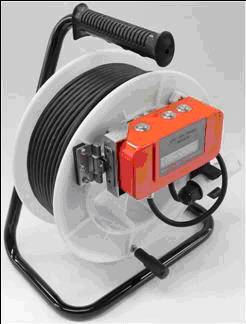
President: Koichi Muto) today announced that MOL and Musashino Co., Ltd. have jointly developed the world’s first portable liquid-level gauge for vessel fuel tanks, which reduces workload needed to measure a ship’s fuel level during bunkering and enables more accurate measurement. This will reduce the crew’s workload, and help prevent incidents such as fuel spills from overfilling.
Features of portable liquid-level gauge for fuel tank:
(1) Compact main unit (24cm wide x 37cm high x 31cm deep), lightweight (about 4.5kg) / Power source of the main unit is 9V dry cells. Digital readouts and superior operability.
(2) Wireless function enables simultaneous monitoring of liquid levels in several tanks.
(3) Bubbles sometimes occur on surface of fuel oil during bunkering. This is called the "cappucino phemomena" and may cause misleading readouts with conventional equipment. The new liquid-level gauge does not register misleading readouts.
(4) Sounding tape and gauge can be used simultaneously.
Even on vessels equipped with fixed liquid-level gauges, crews measure the liquid level manually by hanging sounding tapes into sounding pipes located on the deck, to help prevent overflow and to check bunkering volume during refueling. This operation must be done by a skilled crew, which creates additional burden on the crew as they must measure several tanks simultaneously.
With the new liquid-level gauge, the pressure sensor, which is suspended into the fuel tank, senses changes in liquid-level pressure and detects the fuel level in the tank quickly and accurately. In addition, because of the function of wireless transmission, several tanks can be monitored on the ship’s computer at the same time. This improves the efficiency of fuel level measuring operations, reduces workload, and helps prevent overflows, thus reducing the risk of fuel spills and environmental damage from fuel tank overfill.
In December 2011, MOL invited several shipowners and ship management companies to a demonstration of the system on a vessel under construction. Overflow problems during bunkering and the cappuccino phenomena are common issues in the ocean shipping industry. Comments from observers included “This holds promise in preventing overflow problems,” reflecting their high interest.
MOL set enhancement of safe operation as a key strategy in its midterm management plan "GEAR UP! MOL," and is forging ahead to become the world leader in safe operation. Adoption of this new service and new technology is part of that plan. MOL takes an ongoing proactive stance in the development and introduction of various technologies that will contribute to safer operation.