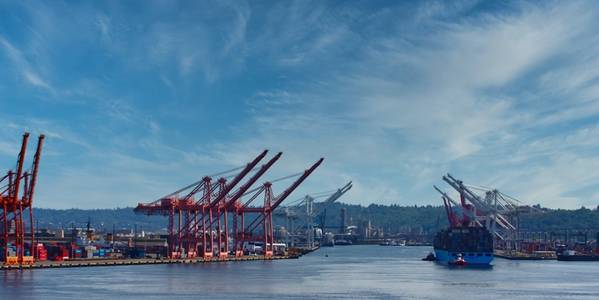
A large number of ports across the United States are making headway toward ambitious decarbonization targets, but many are running up against significant challenges that threaten their progress, according to a new report from classification society ABS and trade group the American Association of Port Authorities (AAPA).
Financial constraints, low technology readiness and physical space limitations are among key obstacles identified the ABS and AAPA report, "Port Decarbonization Survey: Trends and Lessons Learned", which analyzed feedback from AAPA members—including 27 ports and two terminal operators—as part of a joint development project (JDP) between AAPA and ABS.
Nearly 70% of survey participants said their organization has set decarbonization goals, and 90% identified financial constraints as a top challenge toward meeting them. While the vast majority (73%) say they have used state, local or outside programs to help fund their decarbonization projects, respondents said public funding levels are still far too low to achieve goals set by ports and advocates.
“Maritime is by its very nature a cleaner form of transportation, and this survey shows that various ports are already leading emissions mitigation efforts in alternative fuel and electrification options. AAPA intends to leverage this research to push for wise and realistic policies - with collaboration from public and private partners - towards an increasingly sustainable future for the port and maritime industry,” said Cary S. Davis, AAPA President and CEO.
“ABS is actively involved in several infrastructure planning projects around the world, especially regarding shore power connection technologies and the electrification of ports. This report provides an important benchmark for ABS to understand the ability and interest in decarbonization infrastructure at U.S. ports. ABS is uniquely positioned with our deep expertise in regulatory compliance and technological breakthroughs to bring together diverse maritime stakeholders to advance the conversation around sustainability and emissions reduction strategies,” said Panos Koutsourakis, ABS Vice President, Global Sustainability.
“The Georgia Ports Authority is dedicated to decarbonization on a number of fronts, including through the electrification of cargo-handling equipment,” said Tiffoni Buckle McCartney, Manager of Corporate Sustainability at the Georgia Ports Authority and Chair of the AAPA Environment Committee. “This report will help port staff across the country learn from their colleagues, and it will help policymakers understand what is needed to advance port decarbonization.”