As the ballast water treatment market matures, ERMA FIRST is betting that the future belongs not to a single technology, but to engineering flexibility, lifecycle support and operational excellence.
There was a time, not all that long ago, when the ballast water treatment (BWT) business was a technology race. Manufacturers competed to earn IMO and U.S. Coast Guard approvals, shipowners raced to meet retrofit deadlines, and success was measured by installations. Today, that market looks very different. The retrofit boom has largely passed, regulations have become normalized, and owners have years of operating experience behind them. The industry's questions have changed.
And according to Eleni Polychronopolou, President of ERMA FIRST, that's exactly where opportunity begins.
"I actually think one of the biggest changes in our industry is that shipowners are asking much better questions than they were 10 years ago," says Polychronopolou. "During the early years of ballast water management, the discussion often centered on which technology was 'best.' Today, owners recognize that the better question is, 'Which technology is best for my vessel?'"
That distinction has become the foundation of ERMA FIRST's strategy.
Building, Acquiring Multiple Technologies
ERMA FIRST entered the ballast water market with electrochlorination technology. Today, however, the company stands apart for offering one of the industry's broadest treatment portfolios through both internal development and strategic acquisitions, including Ecochlor, RWO and oneTANK. Polychronopolou says that transformation wasn't accidental.
"It was both," she says when asked whether diversification was driven by strategy or market demand. "From the beginning, our strategy was to provide shipowners with the best ballast water management solution for every vessel, not to promote a single technology."
Experience quickly demonstrated that every ship presents a different engineering challenge: available electrical power; ballast capacity; crew experience; retrofit constraints trading routes; water quality … the list goes on, and on, and each variable changes the equation. The result is a portfolio designed around applications rather than products.
Electrochlorination remains the backbone of the business through ERMA FIRST FIT and ERMA FIRST FLOW, particularly for medium and large commercial vessels. Ecochlor's chlorine dioxide technology fills an entirely different niche where electrical power is limited or operational flexibility is paramount. oneTANK addresses compact installations on workboats, offshore vessels, tugs and yachts where conventional ballast water systems simply cannot fit. Meanwhile, RWO strengthened both engineering capability and the company's electrochlorination offering. Rather than asking owners to adapt to one technology, ERMA FIRST is adapting technology to the vessel.
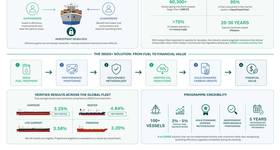
The “Engineering Before Equipment” philosophy extends to every project. Polychronopolou describes a process that begins not with equipment selection but with understanding the vessel itself. "Our objective is to help shipowners identify the solution that delivers the best combination of operational performance, installation practicality, efficiency, and long-term value for their specific vessel," she explains.
It is a subtle but important shift.
Instead of leading with a preferred treatment technology, engineers first examine ballast capacity, available power, trading pattern, water conditions, retrofit limitations, maintenance philosophy and long-term fleet strategy.
Only then does the technology conversation begin.
That approach reflects the reality that ballast water treatment has become an engineering discipline as much as an equipment business.
A Mature Market
Perhaps nowhere is the market's evolution more evident than in how purchasing decisions are made.
During the retrofit years, owners had one overriding objective: install a compliant system before regulatory deadlines.
Today, compliance is simply expected.
"The market has definitely evolved," says Polychronopolou. "Today's purchasing decisions are less about meeting a regulation and more about reducing operational risk. Owners want confidence that they're investing in technology—and in a company—that will continue to support their fleets for many years to come."
That means conversations increasingly revolve around issues rarely discussed a decade ago:
The market itself remains surprisingly healthy despite the end of the retrofit wave.
Newbuilding activity continues. Fleet expansion continues. First-generation systems are reaching replacement age. Fleet acquisitions often leave owners operating multiple ballast water platforms, creating demand for standardization across spare parts, maintenance and crew training.
The ballast water market, in other words, has transitioned from installation growth to fleet optimization.
Service Is the New Differentiator
Another consequence of market maturity is consolidation. Several ballast water suppliers have exited the business altogether. Others have reduced investment in product development or global support. That has fundamentally changed how owners evaluate suppliers.
"Ten years ago, most discussions focused on technology," Polychronopolou says. "Today, they're equally focused on the company standing behind that technology."
Increasingly, shipowners want reassurance that their supplier will still be investing in software, engineering, spare parts and service ten years from now.
Digital capabilities have become an important part of that equation.
Remote diagnostics, predictive maintenance, software updates and continuous system monitoring allow many issues to be identified before they interrupt operations. Combined with global service hubs and experienced field engineers, these capabilities have become competitive differentiators rather than optional features.
In today's market, a ballast water system is no longer simply equipment—it is a long-term service relationship.
Thousands of Ships, Thousands of Lessons
Polychronopolou repeatedly returns to one advantage she believes cannot be duplicated: operational experience. Nothing, she argues, teaches engineers more than equipment operating aboard thousands of vessels under real-world conditions.
"Nothing has influenced our products more than real operating experience," she says. "Laboratory testing and Type Approval establish performance requirements, but thousands of installations operating around the world teach you how equipment performs under real operating conditions."
Those lessons have reinforced surprisingly simple design principles.
Perhaps most importantly, every installation becomes feedback for the next generation of products, with commissioning teams, service engineers and vessel operators continually informing software updates and future designs.
Beyond Ballast Water
While ballast water remains ERMA FIRST's foundation, the company's ambitions extend well beyond a single equipment category.
As part of ERMA TECH GROUP, the portfolio now encompasses tank management, wastewater treatment, emissions reduction, energy efficiency and vessel performance optimization.
Polychronopolou sees a broader trend emerging across the maritime equipment sector. Shipowners increasingly prefer fewer suppliers capable of delivering integrated environmental solutions supported by common digital platforms and lifecycle services.
Rather than managing multiple vendors for separate environmental systems, operators are looking for long-term technology partners.
It mirrors a broader evolution occurring across shipping as digitalization connects previously independent onboard systems into unified operational platforms.
The Third Chapter
Polychronopolou describes ballast water management as entering its third chapter. The first was innovation. The second was execution. Today's chapter, she says, is operational excellence.
"Shipowners already know what the technologies are capable of," she says. "What they're evaluating now is the company behind the technology. Can they support a global fleet? Can they respond quickly when assistance is needed? Will they continue investing in product development, software, digital capabilities, and worldwide service? Those questions increasingly determine purchasing decisions."
That observation may ultimately define where the ballast water market goes next. Type approvals have become table stakes and technology has largely matured.
The winners will increasingly be determined not by who invented a treatment method, but by who can support a fleet over decades of operation.
For ERMA FIRST, that means offering multiple technologies rather than championing one, applying engineering before equipment selection, and viewing every installation as the beginning of a long-term relationship rather than the end of a sale.
It's a philosophy that reflects the maturity of the ballast water market itself—and perhaps offers a glimpse of how other environmental technology sectors in shipping will evolve in the years ahead.