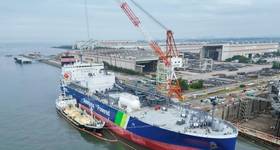
The JSI Alliance has successfully completed a major project in India for client Afcons Infrastructure Limited. Afcons was contracted to construct a new liquid cargo berth for Gujarat Chemical Port Ltd. (GCPL). The JSI Alliance was contracted for the execution of critical heavy lifting operations for the development.
The project scope was complex, requiring heavy-lift capabilities for the installation of eight jackets and fifteen berthing dolphins weighing between 500 and 600 t, at an outreach of 10 m. Work also took place in an challenging environment. The location is subject to a 10 m tidal rise, resulting in currents of up to 5 kn. To compound matters, the seabed is comprised of sand, rendering many conventional mooring solutions unsuitable.
A further factor was that the location was operational at the time of installation; all activities had to be undertaken without interrupting two live, frequently used berths. This resulted in severe space restrictions, leading to further mooring complexities.
Tailored solution
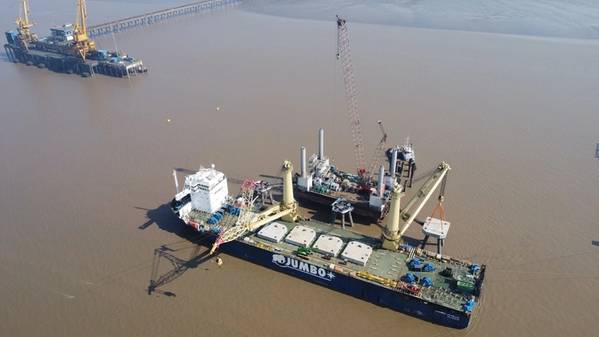
Calling upon the expertise of a wide range of internal disciplines, the JSI Alliance developed a solution fully aligned with the requirements of the project. The Alliance mobilized the heavy-lift vessel (HLV) Jumbo Javelin.
The heavy-lift vessel enabled safe and efficient execution by providing a single platform for the transport and installation of prefabricated structures. Mobilization commenced on November 3 and took place over a period of fifteen days. During this time, the JSl Alliance equipped the Jumbo Javelin with a flyjib that enabled her to perform the necessary lifting scope.
The vessel was also outfitted with an eight-point mooring spread tailored to the seabed and tidal conditions of the project location. Creating sufficient holding force in such a restricted area required utilization of 17t anchors and 64 and 52 mm mooring lines with a Minimum Breaking Lgad of approximately 300 t per line.
The Jumbo Javelin was equipped with custom-made 250 t winches. It was determined that eight, in place of four, winches should be installed to provide a back-up wire, ensuring safety and redundancy.
To absorb the significant forces involved, it was necessary to strengthen the vessel with additional steel. Installation of the spread called upon anchor handling support vessels with sufficient capacity for the heavy-duty components employed. The vessels were required to perform the mooring installation during a four-hour tidal window, when the current was at its lowest speed.
Once connected to the mooring spread, the Jumbo Javelin remained in position for several days at a time, thereby avoiding interruption to berthing operations.
Demobilization and discharge
The first loadout commenced on December 3 at Dighi Port. In total, the Jumbo Javelin made six voyages. The last item was installed on March 14, before the vessel departed for Dighi Port for demobilization, which took place over just seven and a half days.
Following this, the Jumbo Javelin sailed on to Singapore to return equipment to suppliers. Discharge was completed in two days and, on April 6, the project was fully completed.