Engine manufacturers and their engineer teams have put a great deal of thought and money into reducing emissions in recent years. As limitations, particularly in the U.S. and Europe became more stringent, the engineers tuned the engine design with everything from electronic injectors to redesigned combustion chambers.
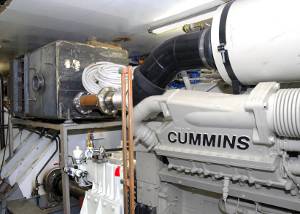
Further mandated reductions in emissions are anticipated. Some operators are not waiting for the regulations but are going to the next level with the aid of independent suppliers. The diesel-electric Stril Mariner is a good example. Another vessel that is setting new standards is the inland waterways cargo ship the M/V Anda. Visscher Scheepsreparatie B.V. completed the China-built 443 ft hull. With an 37.5 ft beam and a depth of 11.7 ft the boat has a depth in the hold of 14 ft including the combing. A pair of Cummins QSK38-M engines supplied by De Groot Scheepstechniek B.V. provides main propulsion. Producing a continuous duty rating of 895 kW (1200 HP) at 1800 RPM. These engines employ a modular common rail fuel system to provide constant high injection pressure regardless of engine speed or load conditions. In addition to reduced noise and vibration as well as idle stability and improved low-end torque, this feature contributes to the engine meeting EU Stage IIIA, IMO and U.S. EPA Tier 2 requirements for reduced emissions.
The owner, J. Verdonk, and the builders of the M/V Anda have taken the emission reduction a whole step further by adding an after treatment system to the engine exhaust. Two sets of the multi component after treatment system, one on each engine, were supplied and installed by Emitech B.V.. Each system consists of a NOx Selective Catalytic Reduction Catalyst (SCR), a NOx control unit, ureum tank, two pieces of urea doseur, a NOx sensor and a NOx buster Bluejet G2 control. Each engine exhaust was also fitted with a DPF Diesel Particulate Filter with a burner and control unit.
In January 2010 test were carried out to measure the emissions of the two engines with the after treatment relative to without after treatment. The results were spectacular. In tests carried out by TNO Industrie en Techniek under the protocols of ISO 8178 (see below) the after treatment system showed that on both engines the NOx emissions are reduced on the weighted test points by almost 90%. (port engine 87% and starboard engine 88%) This brings the NOx emissions on both engines to well below the norm of 2 g/kWh for new ships. These numbers result in the M/S Anda being named the cleanest vessel in the Netherlands and perhaps all of Europe.
The ISO 8178 is an international standard designed for a number of non-road engine applications. It is used for emission certification and/or type approval in many countries worldwide, including the USA, European Union and Japan. Depending on the legislation, the cycle can be defined by reference to the ISO 8178 standard, or else by specifying a test cycle equivalent to ISO 8178 in the national legislation (as it is the case with the U.S. EPA regulations).