Miratech Corporation, designer and manufacturer of emission control products, has been notified that the Patent Cooperation Treaty (PCT) application submitted for its V-CAT catalyst has been accepted. Acceptance of the PCT opens the door to and simplifies the process for subsequent international patent filings.
Under the PCT, Miratech, by filing a single international patent application in one language with one patent office, will streamline the process for seeking protection for its V-CAT design in up to 117 countries throughout the world.
“We've had outstanding success with V-CAT domestically, given its ability to provide operators of EMD diesel engines used to power locomotives, gensets, and marine vessels the means to meet—and exceed— EPA Tier 0, 1, and 2 standards for exhaust emissions. We're excited about taking that success worldwide, and this moves us forward toward doing so,” said Bill Clary, Miratech CEO.
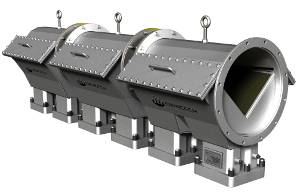
The Miratech V-CAT catalyst/exhaust manifold system addresses a number of engineering challenges that have hampered previous emission control efforts, according to Jonathan Roberts, MIRATECH Sales Manager for Locomotive and Marine Markets. “When designing a Diesel Oxidation Catalyst (DOC) for use in EMD-powered locomotives and commercial marine vehicles, engineers have to deal with limited space behind the turbocharger; exhaust gas temps that are too low for effective DOC performance; and the risk of exceeding the low exhaust back pressures EMD engines need to operate efficiently,” Roberts explained. “We've addressed those in V-CAT by, first, integrating the catalyst directly into the exhaust manifold before the turbocharger with a design configuration that keeps open access to all areas — including the EMD valve covers — needed for regular service and maintenance. At the same time, because gases are hotter upstream from the turbocharger, integrating the V-CAT into the exhaust manifold effectively addresses the issue of low exhaust gas temps. And finally, our customers said they wanted a system that was simple in design; with V-CAT's Plug and Play design, it could not be much simpler.”
V-CAT's efficacy was proven in a 14-month in-service field test, after which the unit was inspected and emissions tested at Southwest Research Institute (SwRI). The inspection found no mechanical issues and emission reductions of 49% PM, 75% HC and 82% CO based on the EPA line-haul cycle measured.
(www.miratechcorp.com)