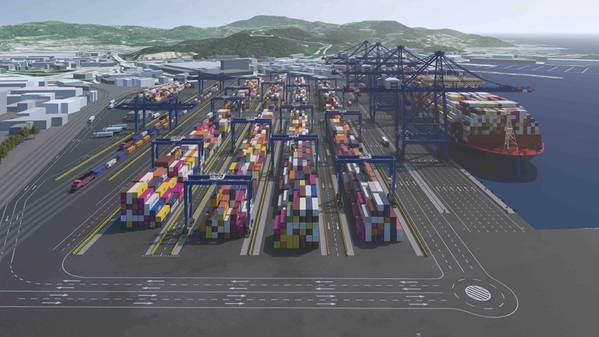
Ahead of the start of construction work on the new Ravano Terminal, La Spezia Container Terminal (LSCT) has signed contracts for the supply of four ship-to-shore cranes and 18 yard cranes, RTGs and RMGs, representing a total investment of USD$104.77 million (90 million euros). The supply agreement has been awarded to a leading Chinese manufacturer; delivery is scheduled to take place within the next 24-28 months.
This milestone represents one of the initiatives paving the way for the development of the new quay and forms part of the wider modernization plan for the terminal. The plan involves a total investment of USD$407.44 million (350 million euros), earmarked for upgrading equipment, enhancing infrastructure and increasing LSCT's overall operational capacity.
The four new ship-to-shore cranes will enable the terminal to handle the latest generation of container ships, including vessels of up to 24,000 TEU.
The planned configuration will allow for the simultaneous handling of three ultra-large container vessels (ULCVs), expanding service capacity on the main international routes. The ship-to-shore cranes will be designed to integrate technological systems; the planned solutions include automatic container identification via OCR (Optical Character Recognition), digital tracking of truck positions during loading and unloading, and vessel profile scanning. Finally, the new yard cranes will feature a cabin-less design for remote controlled operations.
All equipment will be powered by electricity, and, in particular, the terminal's first electric RTGs will be introduced. This decision is in line with the Contship Group's decarbonization and gradual electrification of operational activities, which involves the adoption of energy-efficient solutions and the transition to renewable energy sources.
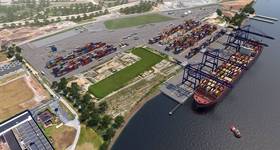
The double C-RMG cranes will be installed at the rail yard being developed as part of the Ravano project, which will feature five sets of tracks. The project aims to strengthen the integration of terminal activities with Contship's intermodal operations. With this configuration, LSCT expects to increase its share of intermodal traffic from the current average of 33% to 50%, meaning that one in every two containers would be transported by rail.