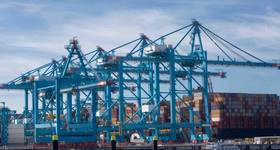
German logistics and transportation company Hamburger Hafen und Logistik AG (HHLA) and its partners began research and development work on the publicly funded FRESH project at its Container Terminal Altenwerder (CTA).
FRESH stands for flexibility management and control reserve provision of heavy goods vehicles in the harbour, said the firm which operates three container terminals at the Port of Hamburg: Altenwerder, Burchardkai and Tollerort, as well as cargo handling and transport services by rail, road and sea.
The goal is to integrate the battery capacities of the automated guided container transport vehicles (AGVs) that are in use at CTA into the German energy network as flexible storage units that contribute to the grid stability of the power supply.
One of the greatest challenges of the energy transition in Germany is the safeguarding of grid stability. By now, the share of renewable energy sources in the German electricity mix is more than 40 percent. This development requires technical solutions by the network providers so that companies and private consumers may soundly be supplied with electricity at all times.
As opposed to power stations driven by fossil fuels, which can provide electricity on demand, this is not guaranteed with renewable energies. Weather dependent energy sources like wind and sun are not always available. This leads to fluctuations that must be absorbed in order to guarantee a consistently secure supply and a stable frequency of 50 hertz (Hz) on the power grid.
Virtual power plants are intended to offset the fluctuations. They digitally link various energy producers and consumers and bundle the offers and needs of the participants. If, for example, a solar park cannot deliver adequate electricity due to weather conditions, a bioenergy plant will power up energy production at the same time. If the wind is blowing particularly hard, stationary energy storage systems can store the surplus power.
Now, for the first time, Hamburger Hafen und Logistik AG and Next Kraftwerke GmbH, one of the largest virtual power plant operators in Europe, are investigating the extent to which industrially used mobile battery capacities can be connected to the German power grid so that primary control reserves may be rendered for grid stability under economic conditions. Terminal operations may not be impaired by this.
By 2022, the approximately 100 AGVs in use at terminal Altenwerder for the transport of containers will be completely converted to fast-charging lithium-ion batteries. In purely mathematical terms, they could then provide 4 megawatts for the energy market at the 18 electric charging stations.
“This is, of course, not their primary purpose – container transport is. But in less busy times, free AGVs could provide battery capacity as mobile power stores to safeguard grid stability,” says Boris Wulff of the CTA Terminal Development department, who is responsible for the FRESH project at HHLA.
Together with Next Kraftwerke, the OFFIS Institute for Information Technology in Oldenburg and the University of Göttingen, HHLA is developing within the three-year FRESH project a process and software solution for accessing the power market. It will digitally control the demands of the virtual power plant operator and smooth terminal operations.