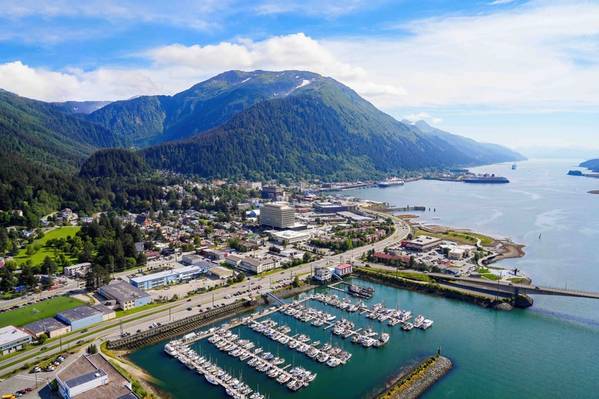
The U.S. Army Corps of Engineers (USACE), U.S. Department of Agriculture, and U.S. Department of the Interior announced Friday their intent to undertake a "Building Infrastructure, Not Paperwork" (BINP) approach to protect Juneau, Alaska, from future glacial lake outburst floods (GLOF). The Corps will soon solicit proposals to tackle the GLOF phenomenon in a way that seeks to expedite infrastructure prototypes on a faster timeline and at a lower cost to taxpayers.
The Mendenhall GLOF challenge is a unique problem across the Army Civil Works enterprise. Under standard processes, a lasting solution to the Mendenhall GLOF would likely have taken 10-plus years and more than $1 billion to complete. Recognizing that an unprecedented challenge requires an unprecedented solution, USACE is working to mitigate both the cost and the long timeline.
The Mendenhall flooding presents a clear and present danger to Alaskans, and the local community seeks quick action. This collaborative partnership prioritizes construction and immediate safety, ensuring federal resources are deployed to design and execute a resilient engineering solution.
The U.S. Army Corps of Engineers recently completed the second phase (Phase 2) of temporary flood mitigation measures in the Mendenhall River Valley in Juneau, Alaska, designed to increase protection for the capital city under threat by the 2026 glacial lake outburst flood. The forthcoming BINP initiative will aim to deliver a permanent infrastructure solution that secures the community for the long-term. The Corps of Engineers will make a formal solicitation related to this challenge in August.