Technology previously demonstrated aboard the U.S. Navy's Stiletto test platform will advance to operational evaluation aboard a Legend-class National Security Cutter.
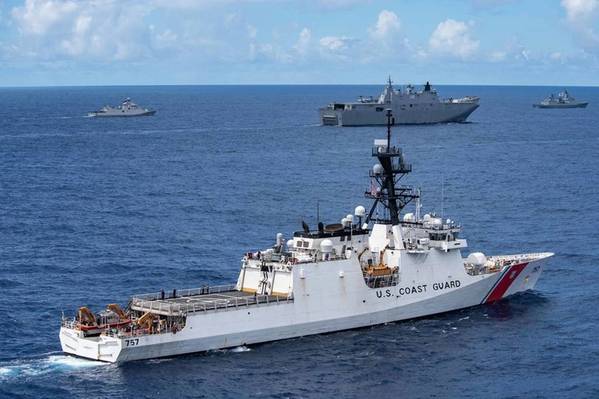
Israel-based maritime technology company Sealartec has secured a U.S. Coast Guard contract under the Foreign Comparative Testing (FCT) Program to supply its ALR-S autonomous launch and recovery system for installation, testing and operational assessment aboard a Legend-class National Security Cutter (NSC).
The award advances the technology from an experimental U.S. Navy platform to a structured evaluation aboard one of the Coast Guard's largest and most capable cutters, targeting one of the more challenging aspects of maritime operations: safely recovering small boats onto moving vessels in increasingly difficult sea conditions.
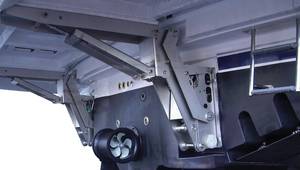
Sealartec's ALR-S technology is designed to automate the stern-ramp recovery process, reducing the need for manual intervention while minimizing the risks associated with relative motion between a small boat and its host vessel.
During conventional stern-ramp recovery operations, wave action and differences in vessel movement can generate significant impact loads, potentially damaging equipment, injuring personnel and limiting the conditions under which recovery can be safely performed.
ALR-S addresses these challenges by autonomously controlling the interaction between the recovering boat and the ship's stern ramp, with the objective of improving recovery consistency, reducing impact forces and expanding the operational envelope.
The Coast Guard evaluation builds on a June 2025 demonstration aboard Stiletto, the U.S. Navy's Joint Prototyping and Experimentation Maritime test platform, in Norfolk, Virginia.
 Stiletto, the U.S. Navy JPEM test platform. U.S. Navy photo by Travis Troller / NSWC Carderock Division.
During that demonstration, Sealartec's technology autonomously managed the capture and recovery sequence after a small boat approached the vessel's stern and matched its speed. U.S. Coast Guard personnel also participated in the demonstration.
The new contract will see a complete ALR-S system provided for installation and assessment aboard a Legend-class cutter.
While autonomous launch and recovery is particularly relevant to the expanding use of uncrewed surface vessels, Sealartec maintains that the technology offers significant benefits for conventional crewed boats as well.
Automating launch and recovery is increasingly viewed as a necessary component of autonomous maritime operations. Even vessels capable of independently navigating and executing missions remain dependent on personnel if their deployment and retrieval require manual intervention.
"We are honored to partner with the U.S. Coast Guard under the FCT framework," said Amitai Peleg, Co-Founder and CEO of Sealartec.
"Stern-ramp recovery systems are widely used, yet all face the same challenge: safe recovery as sea states rise. While autonomous launch and recovery is essential for uncrewed systems, it can significantly improve manned recovery operations as well."
The Foreign Comparative Testing Program evaluates mature technologies developed by allied nations against U.S. military requirements, providing a pathway to assess commercially developed systems without beginning a new development program.
For Sealartec, the contract represents an opportunity to demonstrate ALR-S in an operational Coast Guard environment and gather performance data that could inform future procurement decisions.
The company also develops autonomous connection technologies for refueling and replenishment, addressing other shipboard operations that remain dependent on human intervention.
The Coast Guard contract does not constitute a fleet-wide procurement commitment, but establishes a formal evaluation process for determining the technology's suitability for future operations.