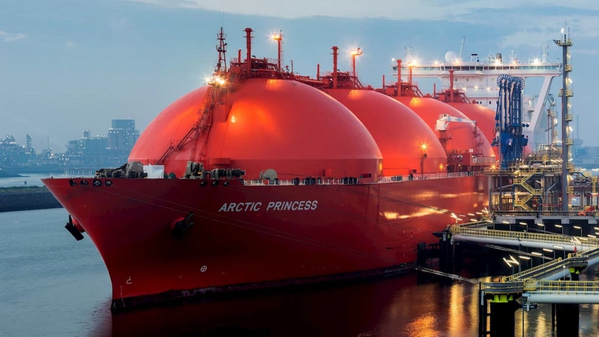
The Port of Rotterdam on Wednesday said it expects sales of liquefied natural gas (LNG) as a bunker fuel to increase in the coming years as ships are forced to switch to cleaner sources of energy.
Europe's largest sea port expects throughput of LNG as a bunker fuel to increase to around 30,000 tonnes this year, up from 9,500 tonnes in 2018, director Maud Eijgendaal told reporters.
"If we keep up this growth we can reach a million tonnes by 2025-2030, which would be around 10% of all bunker fuels sold in Rotterdam", she said.
"In 2020 we expect to have seven or eight bunker vessels in the port area. That is a strong signal that there is a lot of demand. This comes from vessels from all segments: cruisers, tankers, container ships, dredgers; big and small. It looks promising," she said.
The growth in bunkering fuel is part of the rapidly increasing LNG traffic in Rotterdam, where total LNG throughput doubled to almost 4 million tonnes in the first half of 2019.
These large flows are reflected in the usage of Rotterdam’s Gate terminal for LNG, a joint venture of Dutch tank storage operator Vopak and gas company Gasunie.
This facility has already pumped the equivalent of more than 60 billion terrawatt hour (over 5 billion cubic metres) of gas into the European network this year, Gate's managing director Wim Groenendijk said, up from less than 10 terrawatt hour in 2017.
"We had not expected to be so busy", Groenendijk said. "But there are fundamental drivers at work, with a lot of LNG production facilities coming onstream."
The facility currently has a storage capacity of 12 billion cubic metres (bcm), and late last year said it was exploring market interest in increasing this by 2 bcm.
"These discussions are ongoing", Groenendijk said, without providing further details.
"But this expansion is not our priority", he said.
"The priority is to increase the throughput of the terminal. We can increase the speed by which we put gas in the network, for example by increasing the amount of small jetties at the terminal, to facilitate bunkering vessels."
(Reporting by Bart Meijer, editing by Louise Heavens and Alexandra Hudson)