marine link image
Register now for the Port of the Future Conference • 2 Days, 50 Ports • Houston/Galveston area, TX • April 12–14, 2027

New Report Recommends Offshore Energy 'Arctic Standards'

October 3, 2013

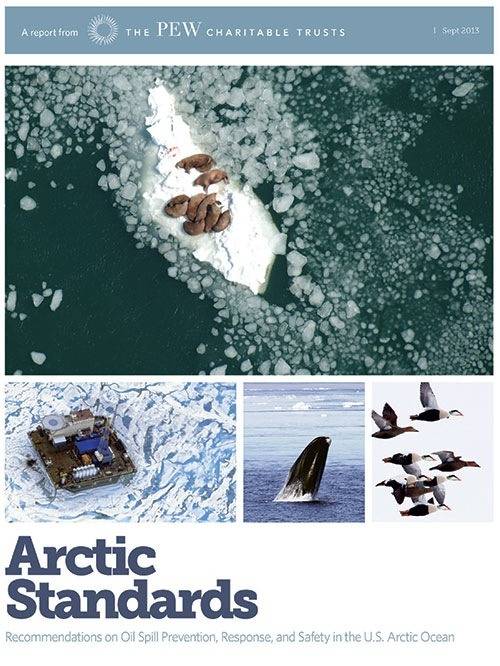
Report Frontispiece: Image courtesy of PEW

A new PEW Charitable Trust report entitled: 'Arctic Standards: Recommendations on Oil Spill Prevention, Response, and Safety, has just been released. A brief explanation follows:

What Are Arctic Standards
Arctic OCS standards would provide consistent requirements on how to design, build, install, and operate equipment to safely explore and develop oil and gas resources and respond to accidents in the region using best Arctic science, technology, and practices. Arctic standards should account for the area’s remote location, lack of infrastructure, and unique operating conditions due to the severe and changing climate to ensure that oil spills are prevented and the capability exists to respond to a worst-case oil spill.

These are some of the changes that Pew recommends:

  • Vessels, drilling rigs, and facilities should be built to withstand maximum ice forces and sea states that may be encountered.
  • Equipment needed to control a spill, such as relief rigs and well-control containment systems, should be designed for and located in Alaska’s Arctic so they can be readily deployed. 
  • Spill response equipment should be located in Alaska’s Arctic and be sufficiently robust to remove oil caught in ice-infested waters and trapped under ice. 
  • Redundant systems—including blowout preventers, double-walled pipelines, double-bottom tanks, and remotely operated controls—should be installed because equipment and logistical access is unavailable for large parts of the year due to harsh weather or ice cover. 
  • Arctic offshore drilling operations into hydrocarbon-bearing zones should be limited to periods when the drilling rig and its associated spill response system are capable of working and cleaning up a spill in Arctic conditions.

Pew believes that decisions about whether, where, and how oil and gas exploration and production activities are conducted in the U.S. Arctic Ocean should be based on sound scientific information, thorough planning, the best available technology, and full involvement of the communities most affected. A balanced and careful approach to development must account for environmental protection and the social, cultural, and subsistence needs of Alaska communities.
 
To access the report go to: http://www.pewenvironment.org/news-room/reports/arctic-standards-recommendations-on-oil-spill-prevention-response-and-safety-85899506213

 

Logistics News

Singapore Ship Registry Marks 60 Years, Plans Digital Upgrade

Singapore Ship Registry Marks 60 Years, Plans Digital Upgrade

European Wheat Prices Rise to One-Week High

European Wheat Prices Rise to One-Week High

US LNG Exports Increase in September, Europe Outbids Asia for Cargoes

US LNG Exports Increase in September, Europe Outbids Asia for Cargoes

FPT, ZEBOX to Advance AI Solutions in Transportation, Logistics

FPT, ZEBOX to Advance AI Solutions in Transportation, Logistics

Subscribe for Maritime Logistics Professional E‑News

Germany's Uniper signss offtake agreement for synthetic green jetfuels
OpenAI data breach is the latest in a long list of cyber-attacks on Australia
Hope fading for new Boeing deal during US-China summit, sources say