Ongoing fleet renewal by niche player Cool Carriers indicates continuing competitiveness at scale of the specialized, pallet-optimized reefership.
Not so long ago, it seemed that the unrelenting march of containerization and ever-widening influence of the powerful ocean container line entities would finally usurp the conventional, breakbulk refrigerated cargo vessel. However, Limassol, Cyprus-headquartered Cool Carriers, the largest operator in the sector, displays remarkable resilience through consecutive programs of tonnage development.
Hard on the heels of a period of renewal centered on five ships in the 900,000-cu.-ft. category, the highest-capacity breakbulk reefers ever commissioned, the company has this year received the first two of seven confirmed newbuilds in the 630,000-670,000 cu. ft. range. Moreover, a further batch of vessels is understood to be in the offing.
Cool Carriers is a practitioner of the service principle known as fast, direct and dedicated (FDD). This is an alternative and a challenge to routings via services run by the large ocean container lines, where overall transit times and overall costs can be higher for refrigerated consignments. FDD is attuned to the particular time and handling sensitivities of fresh produce transportation and niche trades. By using specialized vessels on a direct voyage basis between ports with dedicated infrastructure, it offers shorter delivery times and reduced handling, obviating transhipment, and bestows seasonal flexibility as to shipment volumes.
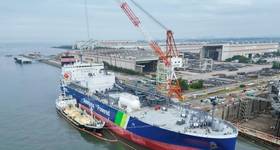
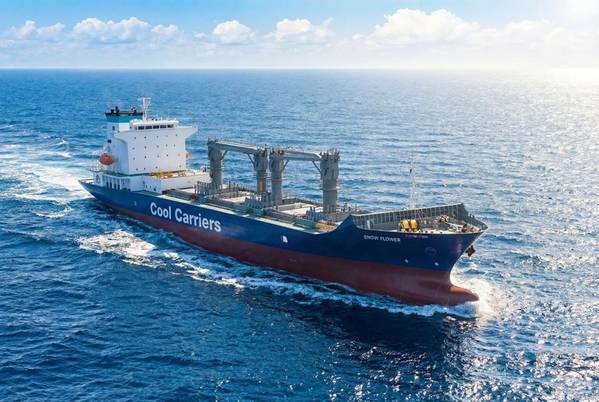
 Snow Flake, second in the Kitanihon series engaged by Cool Carriers. The program reinforces longstanding relationships with the Japanese business community. Image credit: Cool Carriers
As well as operating more than 50 reefer vessels, Cool Carriers has strengthened logistic capabilities by investing in cold storage facilities, as in Ecuador.
The last of five record-breaking, E-class behemoths came from Shikoku Dockyard at Takamatsu in 2025. The follow-on, current stage in the expansion of the Cool Carriers-deployed fleet has been entrusted to Kitanihon Shipbuilding, located at Hachinohe in northernmost Honshu, affording further testament to Japan’s sustained prowess in the design and production of dedicated refrigerated cargo vessels. The program there entails the aforesaid seven vessels, the first of which was handed over in March this year as the 13,287gt Snow Flower, followed in June by sistership Snow Flake.
Snow Flower and Snow Flake each embody a temperature-controlled cargo capacity of 637,700ft3, capable of stowing some 5,000 high-cube pallets of fruit. The subsequent five newbuilds will be somewhat larger, at around 670,000ft3, with one further delivery due before the end of 2026, and the remainder of the series expected through the course of 2027 and 2028.
Main hull dimensions are 158 metres length overall by 25 metres breadth, with a design draft of nearly nine metres, or about 10 metres on summer marks. While customized to owner and charterer requirements, the Snow Flower type is based on the 630,000ft3 design template previously used by Kitanihon in four newbuilds completed during 2024 and 2025 and introduced by French producer Compagnie Frutiere to services maintained by its UK logistics subsidiary Africa Express Line (AEL).
Snow Flower and Snow Flake—adopting Salen nomenclature of the 1970s—are each arranged with four holds subdivided by tweendecks to form 15 cargo compartments, wherein temperatures can be regulated between plus 15degC and minus 25degC. Added flexibility and volume is provided by 150 electrical sockets (‘plugs’) for reefer containers on the upper deck.
A key feature of the design, as was the case with the preceding Cool Express E-series, is the 2.5-metre clearance available in all under-deck spaces, compared with 2.2 metres hitherto. The increase gives space for extra tiers of cartons on high-cube pallets, raising efficiency and competitiveness by matching the internal height of 2.5-metre high-cube reefer boxes.
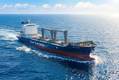
 Record-breaking, specialized reefership capacity: Cool Elegance, last of five E-class vessels built by Shikoku Dockyard. Image credit: Cool Carriers
Self-reliance in cargo handling has traditionally been a characteristic of the reefer cargo ship, and the requisite wherewithal in each of the latest vessels is in the shape of four luffing-type deck cranes, fitted along the centreline to plumb the entire underdeck cargo spaces and above-deck container slots. The foremost (No1) and aftermost (No4) units have dual-mode capability, for 8-tonne pallet loads or for 40-tonne laden container movements throughout the length of the cargo section, whereas the two central cranes (Nos2/3) are rated for 8-tonne lifts.
The wooden gratings at the tweendeck and tanktop levels in the holds have the strength to bear the imposed loads from forklifts moving palletised freight between hook and point of stow.
Each multi-tweendeck/multi-compartment hold is divided into two cooling sections. This enables different cargoes to be carried in each, such as bananas at a precise, constantly maintained plus 13.3degC and apples at plus 1degC, for example.
It has long been the practice in the reefership sector to use available space for auto shipments when the ship is running light, as on a return voyage. Such capability is retained in the Snow Flower type, and amounts to a 526-vehicle capacity.
Main propulsion is by a single, 500 mm-bore 2-stroke of 9,860 kW output manufactured by Japan Engine Corporation (JEC), proprietor of the former Mitsubishi UE range. Laden to a design draft of nearly nine metres, and given fair conditions, the ship can make 18 knots-plus, on a daily burn of 35.2 tonnes of very low sulphur fuel oil (VLSFO), or some 37 tonnes of heavy fuel oil (HFO) with the open-loop SOx scrubber activated.
The heavy electrical load borne by such vessels is implicit in a five-genset plant sized at 6,620 kVA in total. Fuel consumption by the auxiliaries during a laden voyage can accordingly be substantial. For instance, maintaining the correct environment for a full banana cargo can entail a daily usage of nine tonnes of VLSFO, rising to more than 13 tonnes where there is a deck load of up to 130 reefer containers.
Japanese beneficial owners are heavily involved in the evolution of the Cool Carriers fleet. Snow Flower and Snow Flake are owned by Nissen Kaiun, under Singapore registry with the Singaporean arm of the Japanese group. One of Japan’s largest private, family-controlled owners of various types of tonnage, Nissen Kaiun’s business model is to order newbuilds primarily from compatriot shipbuilders for long-term charter or lease to established operators.
The previous stage of Cool Carriers’ fleet renewal, entailing the E-class behemoths of nearly 905,000ft3 , began with the 2018 handover by Shikoku Dockyard of the Cool Express, also beneficially owned by Nissen Kaiun. She was followed a year later by Cool Explorer and subsequently by Cool Eagle in 2021. The final pair, Cool Emerald and Cool Elegance, were brought into commission during 2025.
The Cool Express quintet is widely regarded as the state-of-the-art embodiment of the classical reefer vessel, maximizing operational efficiency, load volume, and trading agility. The design brings record scale to the concept and practice of delivering fast, direct service to shippers of perishable produce, ensuring precise cargo condition control throughout the long sea link in the ‘cold chain’.
Laid out with five holds divided by tweendecks to create 18 cargo compartments, the 180-metre Cool Express class melds a multi-deck capability for transportation of palletized goods requiring in-transit temperatures down to minus 30degC, with the added versatility afforded by slots for 607 TEU or 400 FEU containers, including up to 342 refrigerated units of 40ft. Weatherdeck-borne containers are securely cradled within a lattice of lashing bridges. Working a fruit cargo in the tweendeck-fitted holds of a reefership. Image credit: Cool Carriers
The unique volume of the breed is such that each ship can load around 14,000 high-cube pallets—8,000 in the holds, and 6,000 in containers on deck.
Approximately 800 autos can be shipped on back hauls or ballast legs, and self-reliance at loading points and in port operations generally is conferred by five 40-tonne deck cranes.
Cool Carriers’ legacy embraces a number of the foremost names associated with reefer shipping in past years. It provides the underbed of experience and tradition that continues to move the company forward, with resilience and pragmatism also expressed in today’s modus operandi whereby fleet development is nurtured through business relationships involving Japanese shipowners and investors.
Cool Carriers has Swedish roots, being the 1984 encapsulation of the Salen organization’s longstanding reefership interests. The company has since been central to various stages of industry consolidation, first through a merger with the reefer division of Denmark’s Lauritzen Group, and subsequently through NYK Group’s introduction of its entire reefer fleet. Thus came into being NYKLauritzenCool, presaging a period which saw the Japanese major as part owner and then full owner.
Lauritzen pulled out of the reefer sector in 2007, resulting in the name change of the follow-on entity as NYKCool. Seven years later, NYK also decided to quit the pure reefership segment, whereupon the surviving company reverted to its former name, Cool Carriers.