The oceanographer of the Navy and director of the U.S. Navy's Task Force Climate Change discussed the national security implications of the changing global climate at the United Nations climate change summit in Copenhagen Dec. 16.
Formally known as the United Nations Framework Convention on Climate Change (UNFCCC) Conference of Parties 15 (COP-15), the summit, according to a statement on the convention's website, brings together negotiators, ministers, and world leaders as part of a unified international effort to combat climate change.
"The U.S. Navy is committed to addressing global climate change using a science-based approach," said Rear Adm. David Titley, oceanographer of the Navy and director of the U.S. Navy's Task Force Climate Change.
Titley said that the Navy views the implications of climate change in terms of near- and mid-term impacts, and wild card impacts that are not well-understood by science.
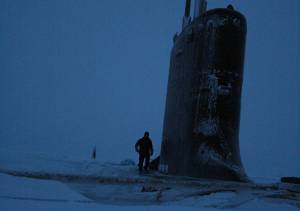
As examples of near term impacts, he described the decline in summer sea ice in the Arctic and the opportunity to build partnerships to adapt to the new environment. "In this context, climate change may be viewed as a 'common enemy' that will bring nations together towards a common end," Titley commented.
For mid-term implications, Titley said changes in temperature and precipitation patterns that may require greater humanitarian and disaster relief missions and that could affect naval infrastructure and force structure.
Wild cards include such concerns as the affects of ocean acidification on subsistence food sources for emerging coastal nations, and the impact of glacial ice sheet melting on the rate of rising sea levels. "Much research is needed to better understand these processes," Titley noted.
Titley described the Navy's response to climate change in terms of assessment and prediction, adaption, and mitigation.
For assessment, Titley focused on computer models and data collection. "Near-term efforts include development of a next generation coupled air-ocean-ice operational prediction system to better predict likely regional impacts the Navy may have to respond to over the next 30 to 50 years, and the deployment of a fleet of oceanographic sensors to contribute to national climate observation systems," he explained.
Adaption, according to Titley, includes increasing naval capabilities in the Arctic and "thoroughly assessing the vulnerability of coastal installations to sea level rise and inundation during storms."
Titley noted that the Navy's response to mitigating the effects of climate change include reducing its carbon footprint and increasing its reliance on alternative fuels. "We have a companion task force, Task Force Energy, which is leading our efforts in climate change mitigation," he said.
Titley emphasized that the Navy is focused on new partnerships, improvements in scientific observations and prediction, and rigorous risk-assessment for future investments. "Global climate change presents the U.S. Navy with both challenges and opportunities that we are addressing through Task Force Climate Change," he said.