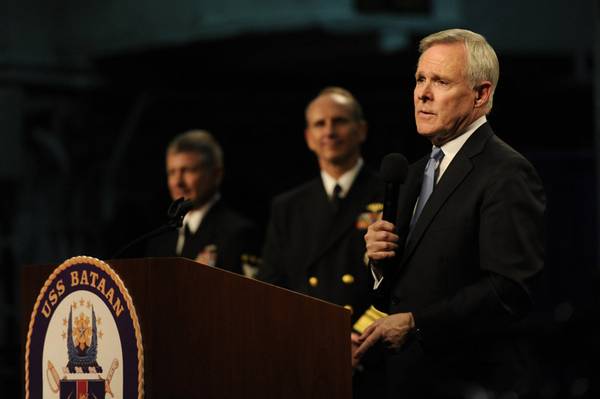
Navy Secretary Ray Mabus sat down with Navy Times to share his vision for the future of the Navy as he begins his fourth year on the job.
Q. Is there anything about the Navy you would like to discuss, anything right off the bat?
A. When you look at the new defense strategy, with its emphasis on the Middle East and the Western Pacific, with its requirement for innovative, low-cost, small-footprint presence elsewhere in the globe, with its requirements with engagement with partners, it’s a very maritime strategy. It requires a great Navy and Marine Corps. It requires a Navy and Marine Corps to be forward-deployed to be very agile, to be very adept at doing anything. And that’s the kind of Navy/Marine Corps we have. I think the strategy recognizes that. And I think that it’s going to make sure that sort of capability continues.
Q. The strategy does point to the Pacific. How do you provide the sort of coverage you need? How are you making sure that every single need is being addressed? Are you going to have to forward-deploy ships? Are you going to have to shift anything around? What’s your strategy? Longer deployments?
A. For one thing, we’ve been there for 70 years. During and since World War II we’ve had a major presence in the Pacific. And our fleet is right now 55 percent in the Pacific, 45 [percent] in the Atlantic. That’s going to change some, it’s going to more 60-40. But as [Chief of Naval Operations Adm. Jon Greenert] keeps stressing, we’re also going to use our ships differently. We already have a carrier strike group in Yokosuka. We already have a Marine amphibious group in Okinawa. We’re going to base four [littoral combat ships] in Singapore. And we’re going to crew them differently, we’re going to have three crews for two ships. And so the crews will fall in on the ships.
A. In Singapore. And that will probably be the template for LCS no matter where they are. But we’re starting in Singapore. And if you look at the Marines, we’re putting Marines ... there’s a process, but we’re putting Marines in Guam. There’s going to be a rotational presence of Marines in Northern Australia. And Marines are coming out of a decade of hard, effective fighting, are going back to maritime roots, back on amphibs. Back doing the things Marines have historically done, and do so well whether it’s engagement, or humanitarian assistance and disaster relief, particularly focused, as we’ve been talking about, on the Pacific. I think the important number to remember is that there will be at least as many Marines west of the international date line once we’ve made these moves, as there are today.