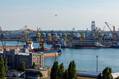
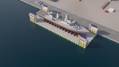
FueLNG, a joint venture between Keppel and Shell Eastern Petroleum (Pte) Ltd (Shell), has achieved the first commercial Liquefied Natural Gas (LNG) bunker transfer in Singapore by completing truck-to-ship bunkering for the Floating Liquefaction (FLNG) vessel, Hilli Episeyo.
The LNG bunker transfer, which was carried out in batches from 22 July to 23 September 2017, was conducted in accordance with the Singapore Chemical Industry Council (SCIC) Technical Reference for LNG Bunkering (TR 56), which provides a safe, efficient and sustainable technical framework for LNG bunkering operations.
This marks the first LNG trucking operation for FueLNG, following the facilitation of Singapore LNG's (SLNG) successful gas-up/cool-down and reload operation at its Jurong Island terminal of the Cardissa, Shell's LNG bunker vessel, in June 2017. FueLNG is committed to building the LNG bunkering industry in Singapore, and is working with relevant local authorities to provide safe truck and vessel bunkering solutions.
Michael Chia, Chairman of FueLNG Ltd, said, "This is an exciting milestone for FueLNG as we establish ourselves as a safe, cost-efficient and reliable LNG bunker supplier. The development of proven LNG bunkering infrastructure will give confidence to the industry that LNG can be widely adopted as a marine fuel and is sustainable for the long-term."
FueLNG has also secured contracts from Keppel Smit Towage and Maju Maritime to provide LNG bunkering services for two dual-fuel LNG harbour tugs. These contracts will commence in 2018 when construction of the tugs is completed.
To promote Singapore as an LNG bunker-ready port, the Maritime and Port Authority of Singapore (MPA) commenced its LNG bunkering pilot programme (LBPP) early this year. Under the LBPP, the MPA has provided various companies with grants of up to S$2 million per LNG-powered vessel constructed.
Andrew Tan, Chief Executive of MPA, said, "This successful operation by FueLNG attests to Singapore's ability to provide safe, efficient, and reliable LNG bunkering in the Port. Furthermore, we are pleased to note that the operation was carried out based on the recently launched Singapore Technical Reference for LNG Bunkering (TR56). As the leading bunkering port in the world, MPA is committed to cater to the future energy needs of the global shipping industry via cleaner, alternative sources of fuels such as LNG. We will continue to work closely with our stakeholders to develop our capabilities in preparation for a larger uptake of LNG bunkering in the future."
Global industry players are poised to pursue greener and more sustainable solutions with the implementation of environmental regulations such as the International Maritime Organisation's (IMO) new 0.5% global sulphur cap on fuel content effective from 1 January 2020.
According to DNV GL, the use of LNG completely removes SOx and particulates, and reduces NOx and carbon dioxide emissions by 85 percent and at least 20 percent respectively. As of March 20172, there are 102 LNG-fuelled ships in operation and 108 on order.