Project partners Eidesvik Offshore, Wärtsilä Norway and DNV GL have announced the closure of the FellowSHIP research project. The cooperation has explored the use of battery, hybrid and fuel cell technology in the maritime industry for over 15 years.
“FellowSHIP has been a flagship research project,” states Bjørn-Johan Vartdal, Maritime Programme Director for Technology and Research in DNV GL Group. “The results from FellowSHIP have shaped our knowledge of battery and hybrid power on board ships and enabled the industry to implement innovations which will help to enable the next generation of more efficient and sustainable vessels.”
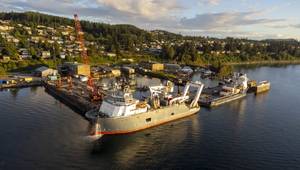
In 2003, the FellowSHIP project partners began laying the groundwork for marine fuel cell technology, developing a proof of concept and the basic implementation principles, all of which culminated in the installation of a prototype fuel cell on board Eidesvik Offshore’s Viking Lady PSV in 2010.
Over the life of the project, the focus shifted to demonstrating the applicability of hybrid battery power systems, especially lithium ion batteries. Now, with class rules established and the technology fully commercialized, the partners have decided that it is time to close the book on the FellowSHIP project.
“Eidesvik is continuously searching for the most forward-looking, efficient and environmentally friendly ship designs and operational solutions for our fleet,” says Vermund Hjelland, Vice President Technology and Development for Eidesvik Offshore. “Upgrading four of our ships with battery systems since 2016 would never have happened without the results, experience and knowledge obtained through the FellowSHIP project.”
“Equinor’s ambition is to be a leader in carbon-efficient oil and gas production, and to reduce emissions from our logistics activities,” says Helge Såtendal, Principal Consultant, Supply Chain Management, Marine Operations for Equinor. “Batteries on platform supply vessels allow for more efficient operation of motors, reducing CO2 and NOx emissions and lowering fuel consumption.”
“FellowSHIP has been an important project for demonstrating, validating and documenting new, efficient and low-emission technologies,” says Ingve Sørfonn, Head of Technology & Development for Wärtsilä Marine Solutions, Power Conversion. “The fuel savings and emission reductions achieved during the different phases of the project have been enablers for developing the maritime industry in a more sustainable direction.”
“Battery and hybrid technology would have made an impact on shipping eventually, but looking back over these 15 years, I think we can safely say that the marine battery revolution started with Viking Lady,” says Øystein Alnes, Principle Maritime Engineer at DNV GL – Maritime. “This project has benefited a great deal from the funding and support of the Norwegian Research Council and is a perfect illustration of how public–private partnerships can help to bring new technologies to market and spur advances in key national industries.”