Nippon Yusen Kabushiki Kaisha, MUFG Bank, Ltd., Nagoya Electric Works Co., Ltd., ArkEdge Space Inc., Shimizu Corporation, City of Yokohama, Yokohama-Kawasaki International Port Corporation, and Yokohama Port Corporation signed a collaboration agreement on November 25 to develop remote sensing technology for measuring greenhouse gas (GHG) emissions from ships at a distance and bringing it into practical use.
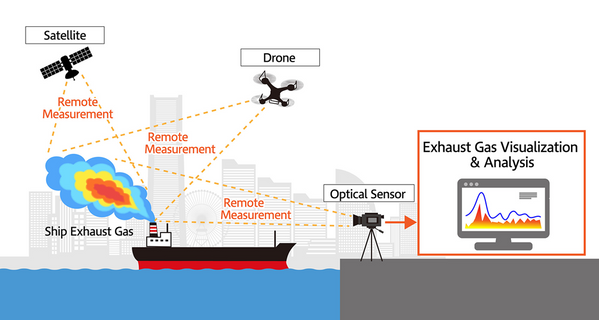
Under the agreement, the eight organizations will advance “True Emission Eye - Maritime,” a project to measure, visualize, and quantify GHG emissions from ships without physical contact. At Yokohama Port as the primary demonstration site, the project will conduct measurements on actual vessels and assess the accuracy of the technology. The project will also examine the specifications of the measurement and analysis system, potential applications and opportunities for future business deployment.
Background
Technologies for objectively assessing GHG emissions from ships are becoming increasingly important as the international shipping industry continues its efforts to reduce emissions.
GHG emissions from ships are primarily estimated based on fuel type and consumption. To complement these estimates, the organizations focus on remote sensing technology that enables direct measurement of GHG emissions from ships at a distance.
The practical application of remote sensing technology has the potential to measure GHG emissions from outside vessels and improve the objectivity and accuracy of emissions assessments. Future wide-area observations using drones, satellites, and other platforms are also expected to help objectively visualize the decarbonization progress of individual vessels and contribute to a more transparent and fair market.
Overview of “True Emission Eye - Maritime”
The project focuses on developing technology to visualize and quantify GHG emissions by leveraging the ability of gases, including carbon dioxide, to absorb and emit light at specific wavelengths. The approach combines ship exhaust data obtained using optical observation technology with relevant physical parameters, such as the distance to the vessel and weather conditions, to calculate emissions.
The project has conducted tests at experimental facilities and measurements on Nippon Yusen Group vessels, both at berth and underway. At Yokohama Port, the project has captured infrared images of ship exhaust from locations including Osanbashi Pier and the Yokohama Bay Bridge Skywalk, and is comparing and analyzing these images with vessel data.
Looking Ahead
The project will continue conducting measurements on actual vessels, primarily at Yokohama Port, to improve the accuracy of its measurement and analysis technology through testing under various conditions and comparisons with vessel data.
The project will also examine observation methods, including fixed-point monitoring at ports, and assess the technical requirements for observing GHG emissions from ships using satellites. The project will also explore the potential integration of satellite observations with ground-based data.
Through continued collaboration, the eight organizations aim to bring the technology into practical use to help improve transparency in GHG emissions from ships and support decarbonization in the shipping and port sectors.