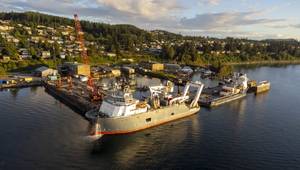
"How to make ships more efficient?" This was the key question posed at the 15th Canadian Committee meeting of Germanischer Lloyd (GL). More than 20 representatives of the Canada and U.S. Flags, ship owners and operators, yards, consultants, and port authorities attended the event hosted by Executive Vice President Americas Capt. Kevin Coyne and Committee Chairman Peter Cairns from the Shipbuilding Association of Canada.
"Reducing the environmental impact of shipping in order to upgrade its image as an environmentally friendly mode of transportation, is one of the most important topics for the maritime industry," he said in his introduction. Apart from fuel efficiency and emissions also statutory delegation and ship recycling was on the agenda. Canada is currently implementing a National Shipbuilding Procurement Strategy aimed at renewing the federal fleet and building world-class shipbuilding capability in Canada, while providing more predictable work for the maritime industry. The overall goal is to strengthen the competitiveness of Canadian shipbuilding yards vis-à-vis European yards in building complex ships.
While there are significant savings from operational and low-level technical changes, the greatest savings generally can be achieved when engineering optimizations are taken into account. Most ships were designed for operating conditions that are no longer valid. For example, a ship with a design speed of 25 knots might be operated at 18 knots in today's environment. "Since its bulbous bow is not optimized for this speed, the generated wave patterns cause the water resistance to increase," explained Volker Höppner from GL subsidiary Future Ship. As a result, fuel costs rise.
But hull lines and bulbous bows alone are not the only determinants of resistance. Höppner said: "That is why FutureShip's ECO-Chances is designed to provide a holistic evaluation of a ship. Utilizing advanced software tools, such as FutureShip's dedicated flow simulation/optimization tools and powerful parametric modeling software, experts assess the ship from top to bottom to identify the most promising focus areas for optimization." A typical evaluation might result in a series of five to six engineering options that offer significant fuel savings. These are presented with estimates of expected savings as well as estimated return on investment.
Some of the suggested options may require additional engineering before implementation. However, hydrodynamic optimizations, for example, often require detailed studies by experienced engineers with advanced software tools in order to optimize results. For these situations, FutureShip offers the services of their engineering experts and partners in the form of its ECO-Solutions service.