The tariff increases by the US and China in effect as of April 25 are estimated to directly affect 4% of dry bulk ton mile demand. They are expected to impact the growth of minor bulk cargo volumes, as shipments to the US may stagnate or decrease. On the other hand, China is expected to increase purchases of dry bulk cargoes from other countries, leading the US to seek alternative markets.
“We expect that the dry bulk market’s supply/demand balance will weaken in both 2025 and 2026. Since our last update, a change in US trade policy has led to a deterioration in the economic outlook and an increase in uncertainty. Consequently, we have cut cargo demand growth by 0.5 percentage points in 2025 and 2026,” said Filipe Gouveia, Shipping Analysis Manager at BIMCO.
The demand outlook is weakest for iron ore and coal shipments, the two largest dry bulk commodities. Iron ore shipments are expected to stagnate in 2025 and 2026, as Chinese domestic steel demand slips, partly due to China’s property sector crisis. Coal shipments are estimated to drop 2-3% in 2025 and 1-2% in 2026, amid rapid deployment of renewable energy capacity and stronger domestic coal mining in China and India, the two largest importers.
On the supply side, an expected decrease in freight rates could lead to a decrease in sailing speeds, as this would allow for savings in fuel costs. Consequently, BIMCO expects supply to grow at a slower rate than the dry bulk fleet.
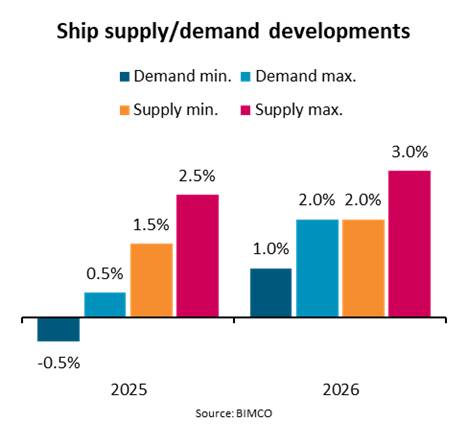
Overall, ship demand is estimated to stagnate in 2025 and grow 1-2% in 2026, whereas ship supply is expected to grow 1.5-2.5% in 2025 and 2-3% in 2026.
“Amid a poorer outlook for the dry bulk market, we expect that freight rates will remain lower in 2025 and 2026, than in 2024. We forecast that the outlook for the panamax segment will be the weakest, as coal accounts for over half of the cargo it transports. Conversely, low fleet growth in the capesize segment could keep that segment’s freight rates higher compared to other segments,” said Gouveia.
The weaker supply/demand outlook should also impact asset prices. Amid weaker freight rates, second-hand ship prices could weaken. Newbuilding prices have fallen since the start of the year, and they are not expected to revert to previous highs.
“In this update, we are assuming that ships are unable to fully return to the Red Sea during the current and next year and reroutings via the Cape of Good Hope will continue. The full return of ships would be equivalent to a 2% decrease in ship demand. If this occurs, the demand outlook will be weaker than our baseline forecast,” says Gouveia.