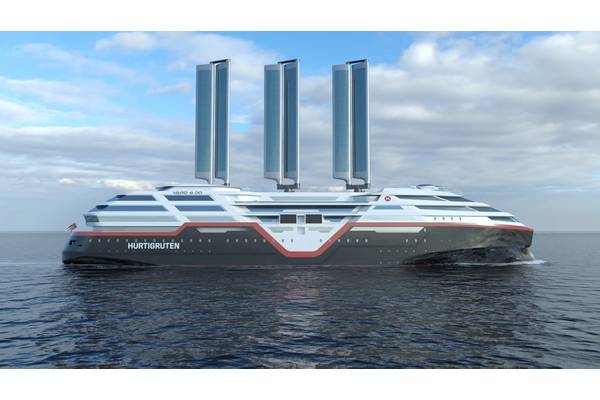
Hurtigruten released updated plans for its Sea Zero project, a zero-emission ship scheduled to debut in 2030 which is now in its R&D phase. The ship, as designed today, will lean on large batteries, sails, and other solutions to sail emission-free during normal operation, while energy consumption could be reduced by 40-50%.
Hurtigruten announced its Sea Zero project in October 2022, and unveiled its first set of renderings in summer 2023. A second version of renderings are now released, developed in Ålesund by Vard.
In addition, the company is also going through a 100 million Euro upgrade of its fleet that includes several ships becoming battery-hybrid-powered and inclusion of technology that will significantly reduce both CO2 and Nitrogen oxides (NOx) emissions by 25% and 80%, respectively.
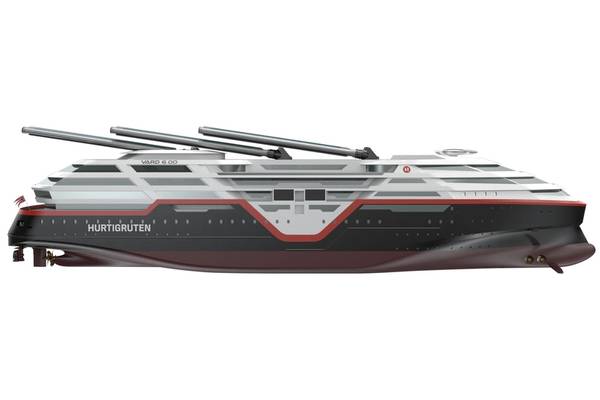
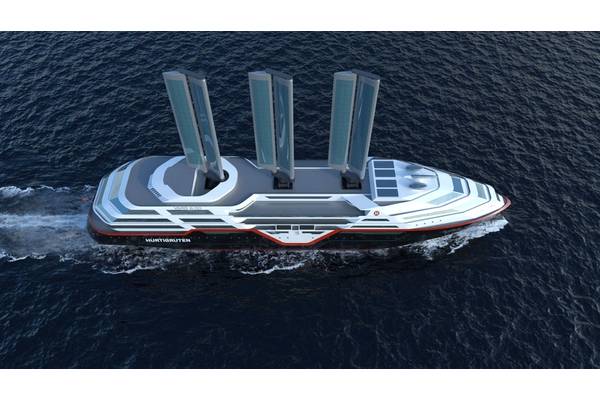
A distinctive feature of the new ship design are the OceanWings sails which can be raised and lowered as needed. Preliminary estimates indicate that the sails could reduce energy consumption by around 10% over time. Additionally, solar panels will contribute another 2-3% in energy savings.
“We still see significant energy savings from having retractable sails with solar panels, but this requires thorough studies, including model tests to be conducted in the coming months. We have also changed the sail type to a more mature design already in use on cargo ships,” said Chief Operating Officer Gerry Larsson-Fedde of Hurtigruten.
The ship is planned with contra-rotating propellers as the main propulsion, and the batteries will have a capacity of around 60 MW hours. Two retractable thrusters at the stern will ensure optimal maneuvering during port operations and provide increased safety through redundancy.
Another tech on trial is air lubrication of the hull, where air bubbles are pumped beneath the hull to reduce drag, a system that reportedly can provide energy savings of 5-10%. Combined with modern hull design, advanced anti-fouling coatings, and regular hull cleaning, water resistance can be significantly reduced. Preliminary results also show that better ventilation and insulation systems, as well as advanced energy management, can lead to significant energy savings.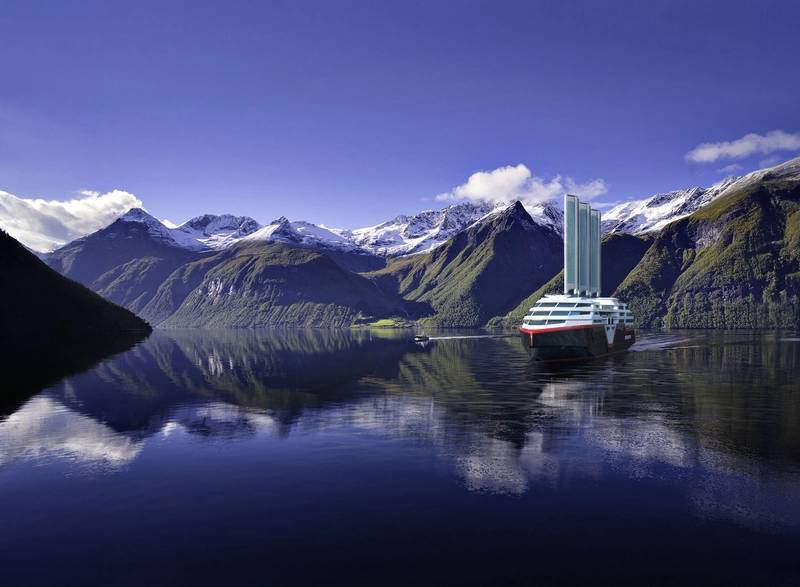 Rendering by Vard, courtesty Hurtigruten