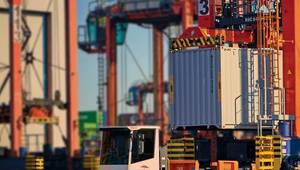
Lloyd's Register is to play a major role in a two year program to test the suitability of bio-diesel for use in powering marine engines The feasibility study will take place on board the Maersk Line container ship, Maersk Kalmar. Collaborators in the biodiesel project are Maersk Line, Maersk Tankers, Maersk Supply Service, Maersk Drilling, Maersk Ship Management, Lloyd’s Register’s Strategic Research Group, and a consortium of Dutch subcontractors. The project is being part funded by the Dutch government and co-ordinated by Maersk Maritime Technology (MSM).
The bio diesel FAME (fatty acid methyl esters) used for the test will be based on sustainable crops grown in (temperate) regions or reused oils. Initially, the scope of the tests will involve using a blend of between 5% and 7% biodiesel, with the blend percentage being steadily increased.
“One of the aims of the tests is to establish the degree to which issues experienced by the automotive industry in the use FAME, will be duplicated on board ship, in particular the impact on storage stability, handling and its subsequent use in the engine. Where adverse effects are arising it is hoped to find solutions to overcome them.” said Kim Tanneberger, Specialist of Lloyd’s Register’s Strategic Research Group (SRG).
In theory, FAME can be used in pure form as an engine fuel, however it has a number of shortcomings as a fuel, putting aside the high costs and limited availability compared to petroleum derived fuels, these include:
• storage stability
• adverse reaction of materials to it (acidity, surfactant properties of FAME)
• susceptibility to microbial growth
• adverse effects on instrumentation of the bilge water system
• poor cold flow properties (cloud point and pour point)
• impact on the level of NOx emissions emitted
• variation of quality of supply world wide depending on feedstock
"Exploring the behavior of our engines and storage tanks and knowing the change in air emissions by using FAME blends onboard will give us valuable knowledge of the opportunities and challenges" said Lasse Kragh Andersen, Senior Environmental Specialist in Maersk Maritime Technology. At an early project workshop in Rotterdam, Lloyd’s Register brought a team of experts from its London and Rotterdam offices to carry out an in-depth hazard and risk analysis of the bio-fuel installation. The Lloyd's Register experts who participated in hazard analysis were Dr. Paul Davies (risk expert), Timothy Wilson (FOBAS), Mark Wharton (engineering systems), Koos Dubois (design support) and Kim Tanneberger (bio-fuel research).
(www.lr.org)