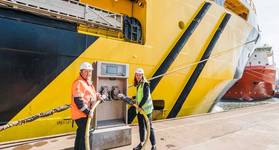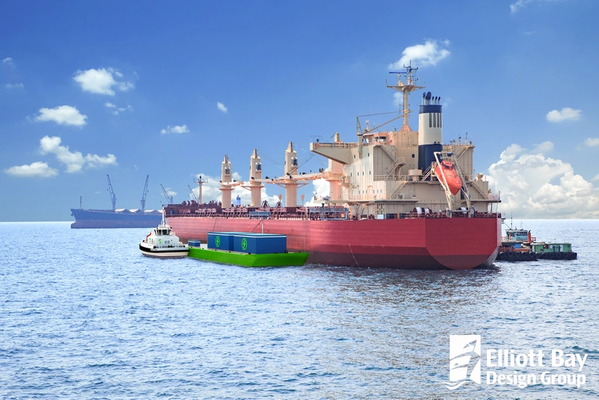
Seattle-based naval architecture and marine engineering firm Elliott Bay Design Group (EBDG) last week unveiled the design for a new barge engineered to offer power and charging to vessels in ports and harbors.
Delivering 7 megawatts (MW) of continuous power generated by methanol, the 225-foot-long floating mobile platform is capable of cold ironing to minimize emissions from large vessels both at the pier and at anchor for up to two weeks before refueling.
In addition, it offers double duty as an "in-field" DC charging station for electric harbor tugs and other smaller service vessels. An independent ultra-low emission and nearly silent 1 megawatt system with 10 megawatt-hours (MWh) of reserve capacity continuously replenishes its reserve to provide fast charging capacity on-demand directly in the operating field of the vessels it serves.
The vessel is equipped with a Wärtsilä W32M Tier IV methanol generator for cold ironing and features e1 Marine's M30 hydrogen reformer technology coupled with PowerCell's PS-185 Fuel Cell system for fast charging. This unique combination of commercially available technologies offers exhaust emission reductions of 70%+ compared with conventional diesel at equivalent power. Zero full cycle emission is also achievable with an optional Wärtsilä carbon capture system and certified green methanol fuel.
The barge features double hull protection of the methanol storage tanks, T1(b) Classification by Lloyd's Register and Marpol 21.1.2 compliance.